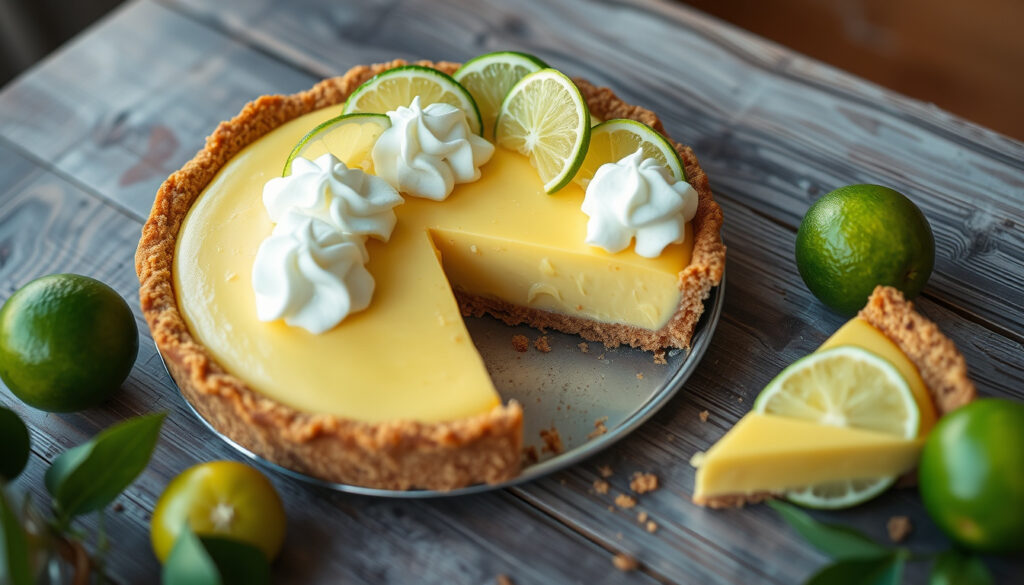
Key Lime Pie Recipe: Classic, No-Bake & Celebrity Variations
There is no neutral ground with Key lime pie: it is either the dessert people request for every birthday or the thing they insist “just isn’t the same” outside the Florida Keys. Yet the classic recipe depends on just a handful of ingredients, and most of the drama comes down to technique — how long you bake it, what kind of lime you squeeze, and whether you give it enough time to set; keep a few exact numbers in mind, and you can make a version that actually holds its shape and tastes like the tropics instead of like a pie from a grocery case.
Calories per slice: approx. 300-400 kcal ·
Prep time: 15-20 minutes ·
Bake time: 15-18 minutes ·
Key limes for 1/2 cup juice: about 20-30 ·
Sweetened condensed milk: 2 cans for standard recipe
Quick Snapshot
- Florida named Key lime pie the official state pie in 2006 (Florida Legislature).
- The classic filling uses egg yolks, sweetened condensed milk, and Key lime juice (Encyclopaedia Britannica).
- Who invented the pie first is still disputed — several families in Key West claim the credit (Michelin Guide).
- Stories that Queen Elizabeth II had a favorite key lime pie are anecdotal.
- Sweetened condensed milk became the practical binder when fresh milk was scarce in the Keys (Encyclopaedia Britannica). (Keys Weekly)
- Key West’s city commission declared the pie its official dessert (Keys Weekly).
- No-bake and cream-cheese variations keep expanding the boundaries of the original recipe (Food Network).
Key Facts at a Glance
Six details explain why the pie behaves the way it does — and why the Florida Keys version became the benchmark.
| Label | Value |
|---|---|
| Origin | Key lime pie originated in the Florida Keys in the late 19th century. |
| State pie of Florida | Designated in 2006 (Florida Legislature). |
| Main ingredient | Key lime juice from Citrus aurantiifolia. |
| Traditional crust | Graham cracker crust, though pastry crust is also used (Giangi’s Kitchen). |
| Sweetened condensed milk | Two 14-oz cans are the standard quantity for one pie. |
| Bake temperature for crust | 350°F for about 8–10 minutes until lightly browned and firm (Giangi’s Kitchen). |
| Filling bake time | 25–30 minutes, with the center set but still slightly wobbly (Giangi’s Kitchen). |
| Storage | Refrigerate up to 3 days; freeze for longer storage. |
| Core flavor | Tart from lime juice, sweet from condensed milk — not artificially green (Giangi’s Kitchen). |
The pattern: the pie’s entire personality depends on a dairy-lime acid reaction, which explains why ingredient substitutions cause so many failures.
What is the best homemade Key lime pie recipe?
- Classic ingredients: key lime juice, egg yolks, sweetened condensed milk, graham cracker crust.
- Authentic versions require key limes (Citrus aurantiifolia) for distinct tartness.
- Baked variations set more firmly than no-bake ones (Food Network).
Classic ingredients and proportions
The traditional formula is easier to remember than most pie recipes because it leans on one pantry hero: sweetened condensed milk. In the late 19th-century Florida Keys, fresh milk was hard to keep cold, so shelf-stable condensed milk became the practical foundation for the filling (Encyclopaedia Britannica).
You need egg yolks for structure, sweetened condensed milk for richness, and enough key lime juice to create that signature tart edge. The crust is usually crushed graham crackers bound with melted butter and a little sugar — but a pastry crust also appears in older versions (Encyclopaedia Britannica).
If you are baking for a crowd and only have Persian limes, the pie will still be good — but it won’t carry the same floral, sour punch that defines the Florida Keys original.
The role of key lime juice vs. regular lime juice
Key limes are smaller, yellower when fully ripe, and more aromatic than the standard Persian limes at most grocery stores. Their juice is more acidic and less bitter, which is why the pie gains a brighter, more perfume-like flavor when you use the real thing (Giangi’s Kitchen).
Bottled juice is the most common shortcut — and the most common mistake. It often adds preservatives and lacks the fresh floral acidity of key limes, and some brands leave a metallic aftertaste (The Fresh Cooky).
Why sweetened condensed milk is non-negotiable
Sweetened condensed milk is not regular milk — it is milk with most of the water removed and sugar added. That high concentration of sugar and protein is what lets the filling set into a soft, sliceable custard. The acid from the lime juice works with the milk’s proteins to thicken the mixture without requiring a traditional bain-marie or flour (Encyclopaedia Britannica).
Using evaporated milk instead is a classic failure: evaporated milk has no added sugar and won’t set the same way, even if the cans look nearly identical (The Fresh Cooky).
Condensed milk is the backbone, so a “light” or “low-fat” version changes the custard’s structure — the pie can come out loose and grainy.
Can you give me a 3-ingredient no-bake key lime pie recipe?
- 3-ingredient version relies on acid from lime juice to thicken condensed milk.
- Cream cheese can create a creamier texture (requires additional ingredient).
- No-bake pies must be chilled at least 4 hours, preferably overnight (Food Network).
Ingredients: sweetened condensed milk, key lime juice, pre-made graham cracker crust
One can of sweetened condensed milk, 1/2 cup of fresh key lime juice, and a store-bought graham cracker crust are the entire shopping list. The acid from the lime juice thickens the condensed milk into a pudding-like filling; the crust stays ready-to-fill so you skip all oven time.
Step-by-step no-bake method
Whisk the condensed milk and key lime juice together until smooth, pour the mixture into the crust, and refrigerate for at least 4 hours — though overnight is better if you want clean slices (Food Network).
If you want a firmer, more stable texture, Food Network’s tested no-bake approach adds gelatin. You hydrate the gelatin in water, warm it until it melts, then temper it with a small amount of filling before mixing it into the rest (Food Network).
Variations: adding cream cheese, yogurt, or sour cream
Cream cheese is the most common no-bake addition because it makes the filling richer and more sliceable; yogurt and sour cream add tang but soften the set. Each variation needs its own chilling test, so start with the base recipe before adjusting ratios.
How do I make Mary Berry’s Easy key lime pie?
- Mary Berry uses a biscuit base, butter, sugar, key lime juice, condensed milk, and eggs.
- Her recipe includes a layer of whipped cream or meringue (varies by edition).
- Bake for 15-18 minutes until just set with a slight wobble.
Mary Berry’s specific ingredient list and method
Mary Berry’s version is a classic British bake: a compacted biscuit crust, a lime-and-condensed-milk filling, and a meringue-style topping that distinguishes it from the American whipped-cream finish. The technique follows the standard method — blind-bake the crust briefly, pour in the filling, and bake only until the center has a gentle wobble.
Her approach leans on the same sweetened-condensed-milk rule that defines the American classic, but the meringue adds height and a toasty finish. If the recipe you are following uses whipped cream instead, that is an intentional variation, not an error.
What are some common mistakes when making key lime pie?
- Using bottled lime juice instead of fresh key lime juice changes flavor and texture.
- Overbaking leads to weeping and rubbery filling.
- Not chilling the pie long enough produces messy slices.
Using bottled lime juice vs. fresh key lime juice
The biggest flavor killer is bottled juice. It is convenient, but it cannot match the floral acidity of freshly squeezed key limes. Many bakers describe a metallic aftertaste, and the pie loses the bright, complex edge that makes the dessert famous (The Fresh Cooky).
Overbaking causing cracks and rubbery texture
A Key lime pie should not look like a firm cheesecake when it comes out of the oven. The filling should be set at the edges but still wobble in the center, then finish setting as it cools. Leave it in too long and the proteins tighten, causing the custard to weep and turn rubbery (The Fresh Cooky).
Not allowing enough chilling time
If you slice the pie while it is still warm or only lightly chilled, the filling will slide instead of cutting cleanly. The no-bake versions are even more demanding: Food Network’s tested recipe calls for overnight refrigeration to achieve the right firmness (Food Network).
Pressing the crumb crust too firmly creates a rock-hard base that crunches rather than yields. Light, even pressure is enough (The Fresh Cooky).
The takeaway: treat the crust and the oven as precision tools, not places to improvise.
Is key lime pie good for you?
- A typical slice contains 300-400 kcal, 15-20g fat, and 30-40g sugar.
- Key lime juice provides 32% of the daily value for vitamin C per tablespoon.
- The pie is calorie-dense, so moderation matters even though some components offer nutrients.
Nutritional breakdown of a typical slice
One slice of classic Key lime pie lands around 300–400 calories, with 15–20 grams of fat and 30–40 grams of sugar. The main contributors are the sweetened condensed milk, butter in the crust, and sugar — not the lime juice.
Key lime juice benefits and health considerations
Key lime juice does provide vitamin C and antioxidants, and one tablespoon covers about 32% of the daily value for vitamin C. But the pie’s overall nutritional profile is dominated by sugar and saturated fat, so it works best as an occasional treat rather than a regular dessert (Encyclopaedia Britannica).
The trade-off: you can reduce the sugar by swapping some condensed milk for Greek yogurt or cream cheese in a no-bake variation, but that will also change the texture and flavor.
Step-by-Step: The Classic Baked Method
- Make the crust, bake it briefly, and cool it before filling.
- Whisk yolks, condensed milk, zest, and lime juice until smooth.
- Bake the filled pie until the center is set with a gentle jiggle.
- Heat the oven to 350°F. Combine 1 1/2 cups graham cracker crumbs, 6 tablespoons melted butter, and 3 tablespoons sugar. Press into a 9-inch pie plate evenly across the bottom and up the sides (Giangi’s Kitchen).
- Bake the crust about 8–10 minutes until lightly browned and firm, then let it cool.
- Lower the oven to 325°F if your recipe calls for a gentler bake, or keep it at 350°F depending on your chosen version.
- Make the filling: beat 4 egg yolks with two 14-oz cans of sweetened condensed milk, 1/2 cup fresh key lime juice, and 1 tablespoon of lime zest. Whisk until evenly combined and slightly thickened (Giangi’s Kitchen).
- Pour the filling into the cooled crust and bake for 25–30 minutes. The center should be set but still show a slight wobble when the pan moves (Giangi’s Kitchen).
- Cool at room temperature, then refrigerate for at least 4 hours before slicing.
The pattern: the steps that make or break a Key lime pie are the ones you perform after the oven — allowing the custard to finish setting in the fridge so the slices actually hold.
Clarity Check: Confirmed vs. Unclear
Confirmed facts
- Key lime pie is a dessert strongly tied to the Florida Keys, and its origin story is still disputed (Michelin Guide).
- Sweetened condensed milk is a standard ingredient because fresh milk was historically scarce in the Keys (Encyclopaedia Britannica).
- No-bake versions rely on acid-thickening reaction and often use gelatin for stability (Food Network).
- Florida named Key lime pie the official state pie in 2006 (Florida Legislature).
What’s unclear
- Which Key West family invented the pie: several claims compete, and no document settles it.
- Whether Queen Elizabeth II actually favored Key lime pie: the story is repeated but only anecdotal.
- Whether the original crust was graham cracker or pastry: old recipes vary.
What this means: the recipe’s history has soft spots, but the technique is consistent across sources.
What Chefs and Bakers Say
“Mary Berry’s recipe from her baking bible emphasizes a crisp crust and a filling that is baked until just set, with a wobble-free center.”
Mary Berry, British baker and cookbook author
“User reviews repeatedly caution against using bottled lime juice — the fresh key lime juice gives the pie its unmistakable bright flavor.”
Allrecipes community reviewers
What these comments share is a warning about shortcuts: the ingredients are few, so every single one has to do its job. Fresh juice and proper chilling are not optional flourishes.
Celebrity versions of key lime pie stay close to that same base. Nigella Lawson’s version often uses cream cheese; Jamie Oliver’s adds Greek yogurt; Paul Hollywood’s keeps the crust as the structural center. None of those changes replaces the core formula — they just nudge the texture in one direction or another.
Summary: The Key Lime Pie Approach That Actually Works
Key lime pie is a dessert where tradition and technique beat innovation. The classic baked custard needs fresh key lime juice, sweetened condensed milk, a restrained hand in the oven, and enough chilling time to set the structure. For bakers who want speed, the no-bake version with gelatin works, but it requires overnight refrigeration to deliver clean slices. For home cooks in the American South, the choice is clear: master the classic recipe first, then experiment with meringue or cream cheese once you can reliably get that tart-sweet balance and a slice that stands up on the plate.
Frequently Asked Questions
Can I use regular limes instead of key limes?
Yes, but the pie will taste different. Regular Persian limes are larger and less aromatic; key limes give the distinctive floral, tart flavor that defines the dessert. If you must substitute, use fresh juice and add a bit more zest to boost the aroma (Giangi’s Kitchen).
How do I store leftover key lime pie?
Cover the pie or wrap individual slices in plastic wrap and refrigerate for up to 3 days. The filling stays stable because of the sweetened condensed milk, but the crust can soften over time.
Can I freeze key lime pie?
Yes. Freeze the fully chilled pie (or slices) wrapped tightly in plastic wrap and foil for up to 1–2 months. Thaw overnight in the refrigerator before serving.
What is the difference between key lime and Persian lime?
Key limes are smaller, rounder, yellow-green when ripe, and more acidic with a stronger floral aroma. Persian limes are larger, darker green, and milder. The flavor difference matters in pie because the filling’s character comes from the lime itself.
How do I make a crustless key lime pie?
Simply skip the crust: pour the filling into a greased pie dish or individual ramekins and bake the custard alone. It will look more like a pudding or a citrus custard, and it needs a longer chill to slice cleanly.
Why did my key lime pie crack?
Cracking usually means overbaking. The custard’s proteins tightened too much and expelled moisture, causing the surface to split. Pull the pie out when the center still jiggles slightly — it will finish setting as it cools (The Fresh Cooky).
Can I make key lime pie without eggs?
Yes. The no-bake method using sweetened condensed milk and lime juice works without eggs; gelatin or cream cheese helps stabilize the filling so it slices cleanly (Food Network).
Is key lime pie gluten-free?
Not as written, because traditional graham crackers contain wheat. Use gluten-free graham-style crumbs or crushed gluten-free cookies as a substitute to make the pie gluten-free.
Related Reading
- Chia Seed Pudding Recipe: Perfect Ratio & Health Benefits — another easy dessert with a simple ratio and a health-conscious twist.
- How to Make Coffee: A Complete Guide to Brewing at Home — a step-by-step brewing guide that pairs well with a tart citrus dessert.
Both guides follow the same logic: a small set of ingredients, precise ratios, and patience at the end.
More related posts
 When to Plant Garlic in NZ: Complete Growing Guide
 UK Passport Renewal from New Zealand: Step-by-Step Guide 2025
 Search Engine Optimisation Auckland: Top Agencies Costs 2026
 One Battle After Another NZ: Where to Watch, Release Date & Flop Rumors
 Cast of Song Sung Blue: Who Sings, True Story & Facts (2025)
 Color Laser Printer Scanner Buying Guide: Pros, Cons & Costs
 How to Change Default Browser on Mac: Safari, Chrome, Firefox
 Hot Water Cylinder Replacement: Costs, Signs & Lifespan Guide