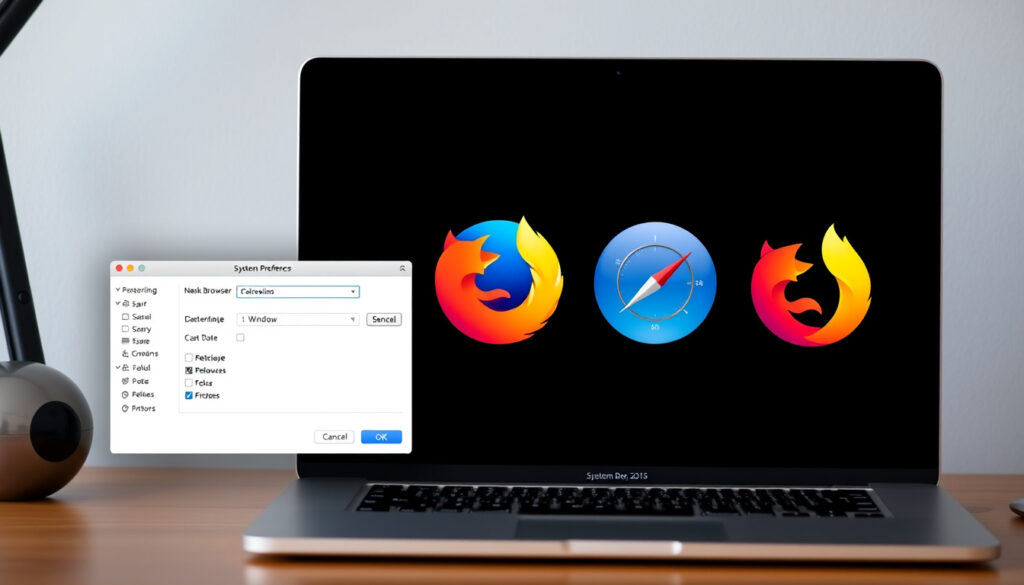
How to Change Default Browser on Mac: Safari, Chrome, Firefox
The default browser setting on your Mac has moved, and that’s why you’re here. I’ll show you exactly how to change it in the current versions of macOS, and what to do when your browser keeps fighting back.
Estimated time to change default browser: 2 minutes ·
macOS versions covered: Ventura, Sonoma, Sequoia (macOS 13, 14, 15) ·
Number of popular browsers supported: 5 (Safari, Chrome, Firefox, Edge, Opera) ·
Official Apple support page: support.apple.com/en-us/102362
Quick snapshot
- Changing default browser via System Settings works on macOS Ventura and later (Apple Support)
- Apple provides official support documentation (Apple Support)
- Chrome, Firefox, and Edge have built-in options to set default (YouTube tutorial)
- macOS Ventura redesigned System Settings, moving default browser from General to Desktop & Dock (Apple Support)
- Later versions (Sonoma, Sequoia) kept the same Desktop & Dock location (Apple Support)
- Future macOS releases will likely retain the System Settings > Desktop & Dock path (Apple Support)
- More browsers will add in-app default setting options on Mac (Apple Support)
The table below condenses the four key details you need to change your default browser.
| Attribute | Value | Source |
|---|---|---|
| macOS version earliest supported for this guide | macOS 13 Ventura | Apple Support |
| Default browser setting location | System Settings > General > Default web browser | Apple Support |
| Number of steps to change default | 3 (open Settings, select browser, confirm) | Apple Support |
| Official Apple support article | support.apple.com/en-us/102362 | Apple Support |
The implication: the setting is only three clicks away once you know where to look, but the redesigned menu in Ventura threw many longtime users off.
How do I change the default browser on my Mac?
System Settings method
On macOS Ventura, Sonoma, and Sequoia, the default browser setting lives in System Settings — not the old System Preferences from earlier versions. Here’s the path:
- Click the Apple menu → System Settings.
- Select Desktop & Dock in the left sidebar (Apple Support).
- Scroll down the right pane to Default web browser — a dropdown menu.
- Click the dropdown and choose your preferred browser (Apple Support).
The change takes effect immediately — no restart needed (Alibaba.com product insights). If your browser doesn’t appear in the list, confirm the browser is installed (Apple Support). On macOS Monterey (12) and earlier, the path was System Preferences → General → Default web browser (OSXDaily (Mac guide)).
Terminal method (advanced)
For advanced users, you can also change the default browser via Terminal using specific command-line tools, but Apple’s official documentation recommends the System Settings route for most users (Apple Support). The Terminal approach is useful if you need to script the change across multiple machines.
Apple’s redesign in Ventura introduced confusion for longtime Mac users. The old General pane in System Preferences is gone — the default browser now lives under Desktop & Dock, a change that even experienced users miss on first try. Knowing this saves the 5-minute hunt most people go through.
How do I switch from Safari to Chrome?
Download Chrome if not installed
First, download Google Chrome from google.com/chrome if you haven’t already. Open the downloaded .dmg file, drag Chrome to your Applications folder, and launch it once. Launching Chrome at least once registers it with macOS, making it visible in the Default web browser dropdown (Asurion (tech support guide)).
Make Chrome default in Chrome settings
Open Chrome. Click the three-dot menu (Chrome menu) → Settings → Default browser. Click the Make default button (YouTube tutorial). Chrome will prompt macOS to open System Settings, where you can confirm the change in the Default web browser dropdown.
Verify default browser in System Settings
Open System Settings → Desktop & Dock. Check that the Default web browser shows “Google Chrome.” If it doesn’t, select it from the dropdown manually. The change applies to all link types — HTTP, HTTPS, and others (Apple Support).
The implication: Chrome’s in-app “Make default” button is the fastest route, but it ultimately hands off to macOS for confirmation. You can skip Chrome’s shortcut entirely and just use System Settings — either way, the result is the same.
Chrome may occasionally reset your default browser after an update. Some users report that Chrome’s background update process, while convenient, can reassign Chrome as default without asking. If links unexpectedly open in Chrome after an update, check System Settings first.
How do I change from Google to Safari on my Mac?
Open System Settings
Whether you’re switching back from Chrome, Firefox, or Edge, the fastest route is through macOS System Settings. Click the Apple menu → System Settings → Desktop & Dock (Apple Support Safari Guide).
Select Safari from Default web browser dropdown
In the right pane, find Default web browser — a dropdown menu. Click it and select Safari. The change applies immediately. Safari is pre-installed on every Mac, so it always appears in this list.
Alternative: Safari preferences
You can also open Safari → Safari menu → Settings → General → check the box next to “Set Safari as default web browser.” This launches System Settings and walks you through the same dropdown selection.
How do I change from Safari to Firefox on a Mac?
Install Firefox
Download Firefox from firefox.com. Drag the Firefox app to your Applications folder and launch it. On first launch, Firefox offers to set itself as the default browser — click Use Firefox as your default browser (YouTube tutorial).
Set Firefox as default in Firefox settings
If you missed the first-launch prompt, open Firefox → Firefox menu → Settings → General. Scroll to the Startup section and click Make Default (Asurion (tech support guide)). macOS will prompt you to confirm in System Settings.
Confirmation via System Settings
As a final check, open System Settings → Desktop & Dock. Verify Firefox appears in the Default web browser dropdown. If it doesn’t, restart Firefox and try again — a common fix is to launch Firefox once and quit it before searching for it in System Settings (Asurion (tech support guide)).
Firefox’s first-launch prompt is the smoothest default-browser onboarding of any third-party browser on Mac. But if you skip it, finding the “Make Default” button inside Firefox’s General settings requires scrolling — it’s not prominently placed.
How to turn off Chrome as default browser on Mac?
Change default to another browser
The simplest way to stop Chrome from being your default: change the Default web browser setting in System Settings → Desktop & Dock to any other browser — Safari, Firefox, Edge, or Opera (Apple Support). The change is immediate and system-wide.
Uninstall Chrome (not recommended)
Uninstalling Chrome works but is overkill — and Chrome stores most user data locally, so reinstalling later restores your old tabs and passwords. A better approach is to simply change the default and leave Chrome installed.
Prevent Chrome from automatically becoming default
Chrome may ask to become the default browser after each update. To stop these prompts: Open Chrome → Settings → Default browser → toggle off “Allow Chrome to automatically set itself as default” or similar wording (Asurion (tech support guide)). Note that this setting may reset after major Chrome updates — Apple’s System Settings is the only bulletproof control.
youtube.com, osxdaily.com, medium.com, support.apple.com, nektony.com, youtube.com, setapp.com
Frequently asked questions
What is the default browser on a new Mac?
Safari is the default browser on all new Macs. Apple pre-installs Safari as part of macOS (Apple Support Safari Guide).
Why does my Mac keep opening links in Safari even after changing default?
This usually happens when the browser you set as default was not launched at least once after installation. Open the browser once, quit it, then check System Settings → Desktop & Dock to confirm the setting (Asurion (tech support guide)).
How to reset default browser to Safari?
Open System Settings → Desktop & Dock → Default web browser dropdown → select Safari. Safari is always listed because it’s built into macOS (Apple Support Safari Guide).
Can I set a different default browser for each user account?
Yes. Each user account on a Mac has its own default browser setting. Log in to each account separately and follow the same System Settings steps.
Does changing default browser affect email links?
Yes — changing the default web browser affects all links that open HTTP/HTTPS URLs, including email links. Your default email app is a separate setting in internet accounts (Apple Support).
How to make Firefox default on Mac if it’s not in the list?
If Firefox is installed but missing from the dropdown, launch Firefox once, quit it, then check again. If it still doesn’t appear, restart your Mac and try again (Asurion (tech support guide)).
Will changing default browser affect my saved passwords?
No. Saved passwords are stored per browser. Changing the default browser does not move or delete passwords stored in Chrome, Safari, or Firefox. Each browser maintains its own password manager.
The core takeaway: macOS makes changing your default browser straightforward — once you know that the setting moved to Desktop & Dock in Ventura. For most users, the entire process takes under two minutes. The real frustration isn’t the change itself, but the browser’s own habit of asking to revert it after an update. For Mac users who prefer Chrome, Firefox, or Edge, the fix is simple: keep System Settings as your authoritative control. Check it whenever your browser updates, and you’ll stay in charge of what opens your links.
More related posts
 Pacers vs Celtics Match Player Stats: Jan 12 & 21 Recaps
 1 USD in NZD: Live Rate, Converter and Trends Today
 Free Road Code Practice Test NZ: 35 Questions, Pass Mark & More
 Remote Control Cars NZ: Complete Buying Guide & Top Retailers
 4 Slice Toaster NZ – Best Picks For Every Budget
 10 Day Weather Forecast Auckland: Accurate & Reliable
 Wheel Alignment Cost NZ: Prices, Signs & When to Get It Done
 Westpac Home Loan Rates Cut – Current Rates and Changes