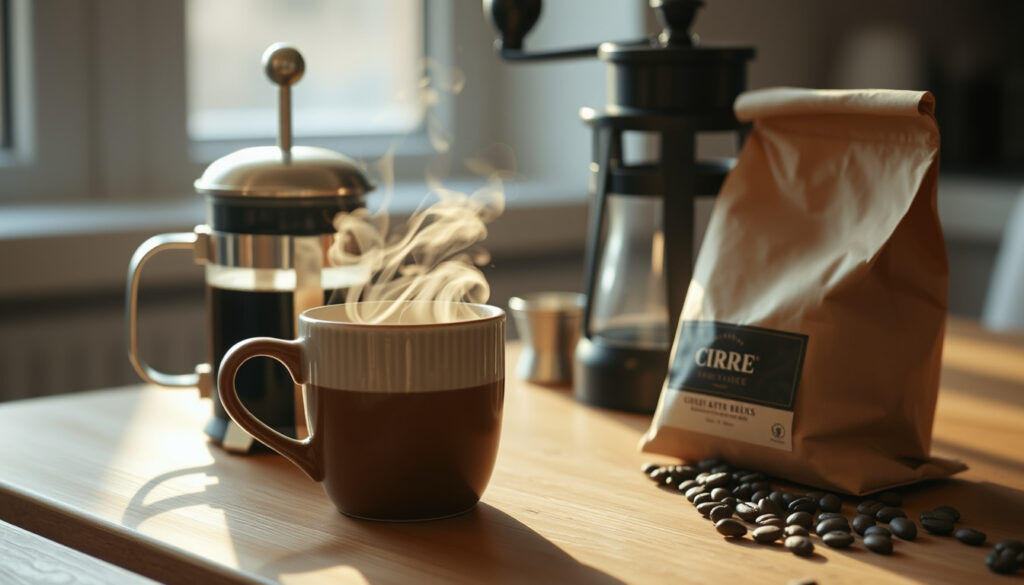
How to Make Coffee: A Complete Guide to Brewing at Home
Anyone who has tried making coffee at home knows the frustration: sometimes it’s bitter, sometimes it’s watery, and the perfect cup feels elusive. But with a few simple techniques and the right coffee-to-water ratio, a consistently delicious brew is well within reach.
Global coffee consumption per year: 166.35 million bags (2020/21, International Coffee Organization) ·
Average cups consumed per day worldwide: Over 2.25 billion ·
Ideal water temperature for brewing: 195–205°F (90–96°C) ·
Standard coffee-to-water ratio (SCA recommendation): 55 g of coffee per liter of water
Quick snapshot
- Easy and automated – ideal for busy mornings (Methodical Coffee)
- Medium grind recommended (Methodical Coffee)
- Use 1–2 tbsp per 6 oz water (Door County Coffee)
- Full-bodied flavor with a coarse grind (Methodical Coffee)
- Steep 4 minutes (Methodical Coffee)
- Ratio 1:12 to 1:16 (Methodical Coffee)
- Strong espresso‑like brew with a fine grind (not too fine)
- Heat on stovetop
- Ratio around 1:7 coffee to water
- Cold brew: steep 12–24 hours, ratio 1:5 to 1:8 (Methodical Coffee)
- Instant coffee: just add hot water (Methodical Coffee)
- Cowboy coffee: boil grounds and settle (Methodical Coffee)
The table below summarizes key brewing benchmarks.
| Label | Value |
|---|---|
| Ideal brewing temperature | 195‑205°F (90‑96°C) |
| Recommended coffee‑to‑water ratio | 1:15 to 1:18 (grams) |
| Average coffee consumption per capita (US) | 3 cups per day |
| Caffeine content per 8 oz cup | 80‑100 mg (drip coffee) |
The implication: temperature and ratio are the two non-negotiable levers for a decent cup.
How to make coffee with a coffee maker?
The simplest route to a consistent cup is an automatic drip machine, a French press, or a Moka pot. Each demands a different grind and ratio, but the fundamentals are the same.
Drip coffee maker
- Use 1–2 tablespoons of ground coffee per 6 oz water (Fellow (specialty equipment maker))
- Water temperature should hit 195‑205°F (Counter Culture Coffee (roaster & educator))
- Medium grind size is standard (Methodical Coffee (specialty roaster))
Most drip machines do the pouring for you, but pre‑wetting the paper filter with hot water removes any papery taste. The Specialty Coffee Association’s Gold Cup Standard recommends a 1:18 ratio (Door County Coffee (roaster & retailer)), though many home brewers prefer a slightly stronger 1:16 or 1:15 (Stone Creek Coffee (roaster)).
Drip machines trade control for convenience: you get repeatable results, but the trade‑off is less ability to adjust extraction mid‑brew. For drinkers who want “set and forget,” it’s the best starting point.
The catch: consistent results depend entirely on using the correct grind and pre-wetting the filter, steps many users skip.
French press
- Coarse grind required to avoid sludge (Methodical Coffee)
- Steep 4 minutes, then press gently
- Ratio falls between 1:12 and 1:16 (Methodical Coffee)
Stone Creek Coffee notes that French press typically tastes best around 1:15 (Stone Creek Coffee (roaster)). The immersion method extracts more oils than paper filters, giving a fuller body.
Italian moka pot
- Fine grind (slightly coarser than espresso)
- Fill the bottom chamber with hot water to just under the safety valve
- Brew ratio is roughly 1:7 coffee to water
The Moka pot uses steam pressure to push water through the grounds. The first few seconds of brew produce the richest coffee; stop the heat once the stream turns pale. Counter Culture Coffee includes it among essential brewing methods (Counter Culture Coffee (roaster & educator)).
How to make coffee without a coffee maker (5 quick methods)?
No machine? No problem. These methods rely on basic kitchen tools and a little patience.
Pour‑over with a paper filter
- Use a medium‑fine grind (Counter Culture Coffee (roaster & educator))
- Pour hot water (just off boil) in a spiral over the grounds
- Ratio 1:16 to 1:18
Atelier Braam describes pour‑over as one of the five methods for making coffee without a machine, emphasizing that a controlled pour mimics a drip machine’s extraction (Peet’s Coffee (roaster)).
Cold brew
- Coarse grind, steep 12–24 hours at room temperature or in the fridge (Methodical Coffee)
- Concentrate ratio 1:5 to 1:8
- Dilute 1:1 with water or milk before serving
Instant coffee
- Simply add 1–2 teaspoons to hot water
- No grinding, no wait
Cowboy coffee (boiling method)
- Add coarse grounds to boiling water, stir, let sit 4 minutes
- Pour slowly or use a spoon to push grounds to the bottom
Using a cloth or makeshift filter
- Fold a clean cotton cloth or paper towel into a cone
- Place in a funnel or cup, add grounds, pour hot water
These no‑maker methods are especially handy during power outages or camping. The catch: without a proper filter, some fines will appear in your cup.
For the home brewer who values equipment simplicity, the pour‑over and cold brew require the least hardware. But the time investment jumps sharply – cold brew demands planning a day ahead.
The pattern: sacrificing equipment usually means sacrificing speed or clarity.
What are the steps to make coffee?
Five universal steps separate a great coffee from a mediocre one. Follow each one with intention.
Grinding the beans
Grind fresh beans just before brewing. The ideal grind size changes with your method: coarse for French press, medium for drip, fine for Moka pot. Freshly ground coffee releases aromatic oils that pre‑ground coffee lacks (Fellow (specialty equipment maker)).
Measuring coffee and water
Use a scale if possible. Ellis Coffee advises starting within a 16:1 to 20:1 water‑to‑coffee ratio by weight (Ellis Coffee (roaster)). For volume, a standard tablespoon holds about 5‑7 grams of ground coffee.
Heating water
Water should be just off boil – 195‑205°F. Boiling water scorches the grounds and extracts bitter compounds.
Brewing
Pour the hot water evenly over the grounds. For immersion methods (French press, cold brew), stir once after adding water.
Pouring and serving
Decant immediately after brewing if using a Moka pot or French press. Coffee left on hot plates turns bitter.
Why this matters: Skipping any of these steps – especially the grind and temperature – will produce a noticeably different cup. The five‑step structure is the safety net for consistency.
How to prepare the perfect coffee in 9 steps?
A more detailed routine adds nuance. Here is a methodical 9‑step process used by specialty roasters.
- Choose fresh beans – use within two weeks of roasting (Stone Creek Coffee (roaster))
- Grind properly – match grind size to method
- Measure – 55 g of coffee per liter of water is the SCA golden ratio (Fellow (specialty equipment maker))
- Heat water – 195‑205°F
- Wet filter – removes paper taste and preheats the vessel
- Add coffee – tamp lightly for espresso, otherwise level
- Bloom – pour a small amount of water, wait 30 seconds for CO₂ release (Counter Culture Coffee (roaster & educator))
- Pour – slowly in circular motions
- Enjoy – preheat your cup to maintain temperature
All 9 steps reinforce the same principle: controlled extraction. Skip the bloom and you lose some flavor complexity; skip the wet filter and you get a paper‑tinged edge.
How to make good coffee at home?
Quality at home is less about gear and more about habits. Here are the five most impactful adjustments.
Use fresh beans
Coffee beans lose flavor within two weeks of roasting (Stone Creek Coffee (roaster)). Buy from a roaster that stamps roast dates on the bag.
Store coffee properly
Keep whole beans in an airtight container away from light, heat, and humidity. Avoid the freezer – condensation damages the beans.
Use correct water temperature
195‑205°F is the sweet spot. Too hot and you extract bitter tannins; too cool and you get sour, under‑extracted coffee.
Clean equipment
Oil residue from previous brews turns rancid. Rinse the carafe, portafilter, and brew basket after each use. A monthly descaling with vinegar removes mineral buildup.
Adjust grind size
Grind finer if coffee tastes weak or sour; grind coarser if it tastes bitter or over‑extracted. Small adjustments make big taste differences.
The pattern: Almost every quality issue traces back to bean freshness, water temperature, or grind size. Fix those three and you solve 90% of problems.
How much water for a cup of coffee?
Water quantity determines strength. The standard coffee industry “cup” is 6 oz, not the 8 oz mug you might use.
Standard ratio: 1–2 tablespoons per 6 oz water
For a robust 8 oz mug, use 2 tablespoons. The Specialty Coffee Association recommends 55 g of coffee per liter of water (Fellow (specialty equipment maker)).
Use a scale for accuracy
Volume measures vary by grind density. A scale eliminates guesswork. Start with 16‑18 g of coffee per 240 ml of water.
Adjust to taste
If the coffee is too strong, add hot water after brewing (American‑style). If too weak, use more coffee next time – less water will shift the ratio but also reduce volume.
Door County Coffee notes that a common starting ratio is 1:15 for a richer cup (Door County Coffee (roaster & retailer)).
A scale is the single upgrade that has the biggest impact on consistency. A $15 kitchen scale beats a $200 coffee machine in terms of quality control.
The catch: most drinkers measure by volume, which introduces inconsistency from one grind to the next.
What we know and what’s still debated
Confirmed facts
- Coffee contains caffeine, a stimulant.
- Brewing temperature affects extraction of flavors and oils.
- Freshly ground coffee yields better flavor than pre‑ground (Fellow (specialty equipment maker)).
What’s unclear
- The best brewing method is subjective and depends on taste preference.
- Optimal extraction time varies by method and grind size – no single number fits all.
“For a clean, bright cup, use a coarse grind and let the water flow through naturally. Don’t force it.”
— L’Arbre à Café (French coffee roaster), recommending 60 g per liter for coarse grind
“Start with a clean filter, add your coffee, then pour water in stages. The bloom is where the magic happens.”
— Maison du Café (coffee brand), describing filter coffee steps
“When you have no machine, a simple pour‑over with a paper filter gives you surprising control. Just watch your pour speed.”
— Atelier Braam (coffee guide), on no‑maker methods
For the home brewer who wants to stop wasting coffee on mediocre cups, the choice is clear: invest in a scale, grind fresh, and control water temperature. Or keep guessing – and keep throwing away bitter brews.
completehomebarista.com, homtone.com, en.wikipedia.org, coffeebydesign.com
Frequently asked questions
How long does coffee stay fresh after brewing?
Brewed coffee loses its peak flavor within 30 minutes. After an hour, it turns bitter and flat. Store in an insulated carafe to extend freshness.
Can I reuse coffee grounds to make another cup?
Yes, but the second brew will be watery and weak – most of the soluble flavor compounds are extracted in the first brew. It’s better to compost spent grounds.
What is the difference between Arabica and Robusta?
Arabica has a milder, more complex flavor with higher acidity; Robusta is stronger, more bitter, and contains about twice the caffeine. Most specialty coffee is 100% Arabica.
How to make iced coffee?
Brew a double‑strength batch using a 1:8 ratio (or cold brew concentrate), then pour over ice. Diluting ice melts and weakens regular coffee, so start strong.
How to fix bitter coffee?
Bitter coffee is usually over‑extracted. Use a coarser grind, lower water temperature, or shorter brew time. Also check that your equipment is clean of old oils.
What is the best grind size for a French press?
Coarse – resembling sea salt. Too fine and you get a muddy, over‑extracted cup with sediment.
How much caffeine is in a cup of coffee?
An 8 oz drip coffee contains 80‑100 mg. Espresso packs about 63 mg per 1 oz shot. Cold brew concentrate can be higher due to the longer steep.
More related posts
 Internet Cafe Near Me in Ireland: Open Spots & Prices
 Colombian Primera A Standings 2026: Live Table & Guide
 Wellington Station Signal Failure: Causes, Impact & Updates
 Black and Decker Battery: Compatibility, Lifespan & Troubleshoot
 Disney Plus NZ Price – Current Plans and Subscription Costs
 Best Movies to Watch: Top IMDb, Netflix & All-Time Picks
 Wheel Alignment Cost NZ: Prices, Signs & When to Get It Done