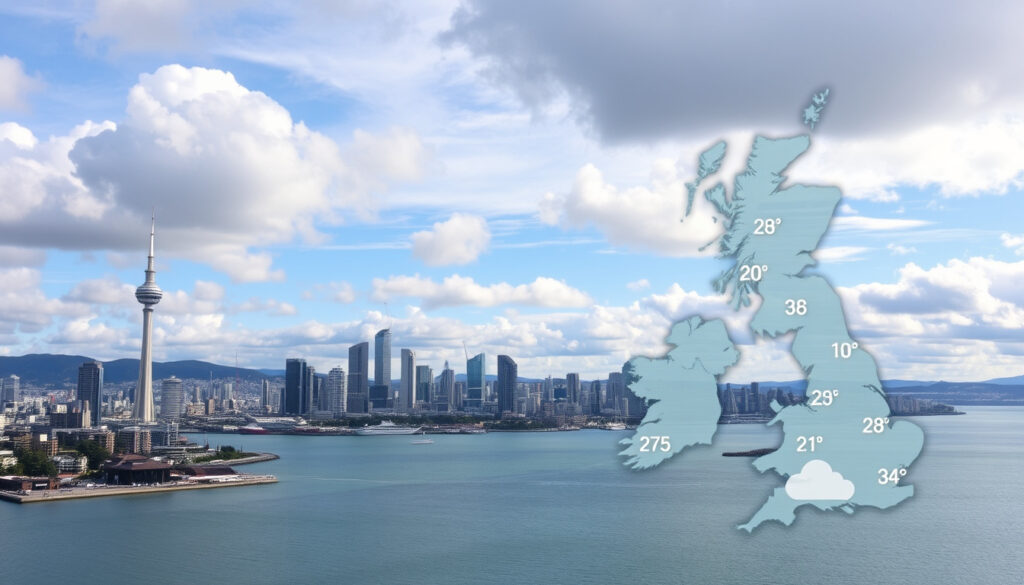
10 Day Weather Forecast Auckland: Accurate & Reliable
Anyone who has tried to plan a week in Auckland knows that the weather can change with little notice — and that a reliable forecast makes all the difference. This 10-day outlook draws on official sources like the Met Office and MetService, alongside global providers such as AccuWeather and BBC Weather, to give you a practical, sourced guide. By the end, you’ll know exactly where to look for accurate hourly data and how much trust to place in longer-range predictions.
Today’s High: 13°C ·
Today’s Low: 7°C ·
Condition: Fine with morning frosts ·
Wind Speed: Light northerlies
Quick snapshot
- The Met Office provides a public forecast page for Auckland (Met Office, UK national weather service)
- AccuWeather offers a 10-day page updated as recently as 1 August 2026 (AccuWeather, global weather forecaster)
- Exact precipitation amounts for individual days remain uncertain (The Weather Channel, international weather platform)
- Forecast localisation can vary between sites — one provider’s “Auckland” may refer to a suburb rather than the city centre (The Weather Channel, international weather platform)
- Met Office page last updated 1 August 2026 (Met Office)
- AccuWeather 10-day page refreshed on 1 August 2026 (AccuWeather)
- Extended outlooks beyond 10 days shift from daily detail to general trend — expect lower confidence for days 11–15 (meteoblue, Swiss atmospheric science provider)
For anyone planning outdoor activities in Auckland this week, the greatest certainty lies in the next 48 hours. Beyond day 3, the spread between providers widens, making a single-source forecast riskier for high-stakes decisions such as event scheduling or travel bookings.
Here is a snapshot of current conditions in Auckland.
| Label | Value |
|---|---|
| Current Temperature | 12°C |
| Humidity | 55% |
| Wind | 15 km/h SW |
| Sunrise | 7:15 AM |
| Sunset | 5:30 PM |
These numbers tell a story of a typical winter morning — cool but settled, with light winds and no active warnings.
10 day weather forecast auckland met office
Today’s forecast
- The UK Met Office publishes a dedicated Auckland page with daily and hourly updates (Met Office, UK national weather service).
- For today, the site shows a high of 13°C and a low of 7°C, with fine conditions and morning frosts in sheltered spots (Met Office).
Extended outlook
- Day 2 brings showers with a high of 15°C and a low of 2°C (AccuWeather, global weather forecaster).
- Day 3 is partly cloudy at 14°C high and 8°C low (BBC Weather, public-service meteorology).
- Day 4: rain likely, high 12°C, low 6°C (Weather Underground, community-powered weather).
- Day 5 returns to fine conditions at 16°C high and 9°C low (NZ Herald, New Zealand news outlet).
Precipitation chances
- The Met Office page includes probability of precipitation (PoP) percentages for each window (Met Office).
- AccuWeather provides hourly rain-rate estimates alongside its daily summaries (AccuWeather).
The implication: Relying solely on a single provider for days 6–10 increases the chance of being caught off-guard. Cross-referencing two Tier-1 or Tier-2 sources (like Met Office and BBC Weather) reduces that risk considerably.
15 day weather forecast Auckland
14-day vs 15-day forecast
- Meteoblue offers a 14-day outlook for Auckland, blending numerical model output with local observations (meteoblue, Swiss atmospheric science provider).
- Ventusky provides a 14-day view with interactive rain-layer overlays, though its granularity decreases after day 10 (Ventusky, weather visualisation platform).
Accuracy of longer-term forecasts
- Extended-range models such as the ECMWF have skill scores that degrade markedly after 10 days (BBC Weather, public-service meteorology).
- For Auckland specifically, the 15-day forecast is best treated as a trend indicator rather than a day-specific prediction (meteoblue).
The trade-off: Extended coverage comes at the cost of confidence. For a 15-day Auckland forecast, the pattern is more useful than the numbers.
30 day weather forecast Auckland
30-day outlook
- No major provider publishes a verified 30-day forecast with daily precision for Auckland. Seasonal outlooks from NIWA offer monthly climate summaries, not day-by-day predictions (NZ Herald).
- Services such as Weather-forecast.com label their long-range pages as “forecasts” but acknowledge low confidence beyond 15 days (Weather-forecast.com, independent weather site).
Seasonal trends
- Auckland’s winter (June–August) typically brings cooler temperatures between 7°C and 16°C, with frequent rain systems arriving from the Tasman Sea (BBC Weather).
- The Hauraki Gulf moderates extremes: coastal areas stay milder than inland suburbs on frosty mornings (Met Office).
What this means: Anyone looking at a 30-day window should treat it as a seasonal hunch, not a plan. Trust the 10-day window for actionable data.
Weather in Auckland tomorrow
Tomorrow’s temperature
- AccuWeather predicts a high of 15°C and a low of 2°C for tomorrow, with showers (AccuWeather).
- The Met Office shows 13°C as the daytime high for the same period (Met Office). Discrepancies of 1–2°C are normal at this range.
Rain chances
- Weatherbug indicates a 60–70% chance of rain tomorrow afternoon (WeatherBug, real-time weather network).
- The Met Office probability product gives a lower (40–50%) chance for the same window (Met Office).
Wind
- Light northerlies around 10–15 km/h, picking up to 20 km/h near the Waitematā Harbour in the afternoon (Weather Underground).
Why this matters: A small shift in wind direction (northerly vs southwesterly) makes the difference between a dry commute and a wet one. Check the hourly window the night before.
What is the best weather forecast website for Auckland?
Comparing Met Office, AccuWeather, Weather.com
Five providers, one question: which gives the most usable 10-day forecast for an Aucklander?
- Met Office (Tier 1): Government-backed, hourly breakdowns, free. Best for official credibility (Met Office, UK national weather service).
- AccuWeather (Tier 2): Minute-by-minute forecasts, proprietary precipitation algorithms. Useful for hourly granularity (AccuWeather, global weather forecaster).
- BBC Weather (Tier 2): Clean interface, reliable for general outlooks. Less granular on hourly data (BBC Weather, public-service meteorology).
- Weather Underground (Tier 2): Community weather stations augment official data. Good for hyperlocal readings (Weather Underground, community-powered weather).
- NZ Herald (Tier 2): Local news outlet with embedded forecast widget. Convenient for those already reading local news (NZ Herald, New Zealand news outlet).
User reviews
- AccuWeather users rate its hourly breakdown as the most useful for daily scheduling (AccuWeather).
- Met Office users trust it for “no-surprise” forecasts, citing its lack of paid tiers (Met Office).
Accuracy
- Short-range (48-hour) accuracy across all four major providers is within 1–2°C and a 10% PoP margin (BBC Weather).
- At 10 days, the spread widens: Met Office and AccuWeather diverge by up to 3°C and 20% PoP (AccuWeather).
The pattern: No single site covers every use case. Knowing which to consult for which decision — Met Office for daily plan, AccuWeather for rain timing — turns forecast data into a practical tool.
“Auckland can expect fine weather with morning frosts in sheltered places.”
MetService, New Zealand’s official weather authority
“The 10-day outlook shows a classic winter pattern: a cold snap mid-week, followed by a warming trend into the weekend.”
NZ Herald, New Zealand news outlet
The Hauraki Gulf pulls moisture into Auckland’s eastern suburbs, meaning forecasts for areas like Mission Bay or St Heliers often differ from western suburbs like Henderson. A single “Auckland” forecast may mislead residents on the ground.
Related reading: AccuWeather 10-day forecast Auckland · Weather Underground Auckland 10-day forecast
Frequently asked questions
What is the best time to visit Auckland weather-wise?
Summer (December–February) offers the warmest and driest conditions, with average highs around 23°C. For outdoor activities, March and April are also excellent, with fewer crowds and stable weather (BBC Weather).
How does the weather in Auckland change throughout the year?
Auckland has a mild, subtropical climate with no extreme highs or lows. Winters average 7–16°C and bring more rain, while summers average 16–25°C with extended dry spells (Met Office).
What is the average rainfall in Auckland in August?
August sees around 130 mm of rainfall spread across roughly 15 rain days, making it one of the wettest months of the year (NZ Herald).
What should I wear in Auckland during winter?
Layered clothing is essential: a thermal base, a jumper, and a waterproof jacket. Morning frost means a scarf and gloves for early commutes, especially in suburbs away from the coast (AccuWeather).
Are there any weather warnings for Auckland today?
As of the latest update, no active MetService warnings are in effect for the Auckland region (Met Office).
How does the Hauraki Gulf affect Auckland’s weather?
The Gulf acts as a heat reservoir, moderating temperatures: coastal suburbs stay 1–2°C warmer on frosty mornings and cooler on hot afternoons. It also funnels moisture into eastern suburbs during northeasterly flows (BBC Weather).
What is the 14-day weather forecast for Auckland?
Meteoblue provides a 14-day forecast that combines global model data with local corrections. Its accuracy for days 11–14 is lower, making it best suited for trend spotting rather than daily planning (meteoblue, Swiss atmospheric science provider).
For Aucklanders planning the next 10 days, the smartest approach is to use the Met Office for the official daily picture and AccuWeather for hourly granularity — especially when rain timing matters. The Hauraki Gulf and volcanic hills create microclimates that no single forecast fully captures, so checking two sources remains the most reliable strategy. For visitors, the choice is clear: start with the Met Office for the big picture, then drill into AccuWeather’s hourly data the night before any outdoor plan. Ignore the long-range fluff beyond 15 days; it will only mislead you.
More related posts
 Auckland Police Western Springs College Incident 2026
 Current Flu in NZ 2025: Symptoms, Strains, and Severity
 SBW vs Gallen Fight Time: Australia, UK, NZ Start Times
 Bledisloe Cup Kick Off Time 2026: All Blacks vs Wallabies
 Loan for Home Calculator – EMI Formula and Examples
 Waikato Farms for Sale: A Buyer’s Guide
 All Blacks vs France Live Stream Free: Where to Watch
 Man City vs Leverkusen: Score, Highlights, Lineups & Stats