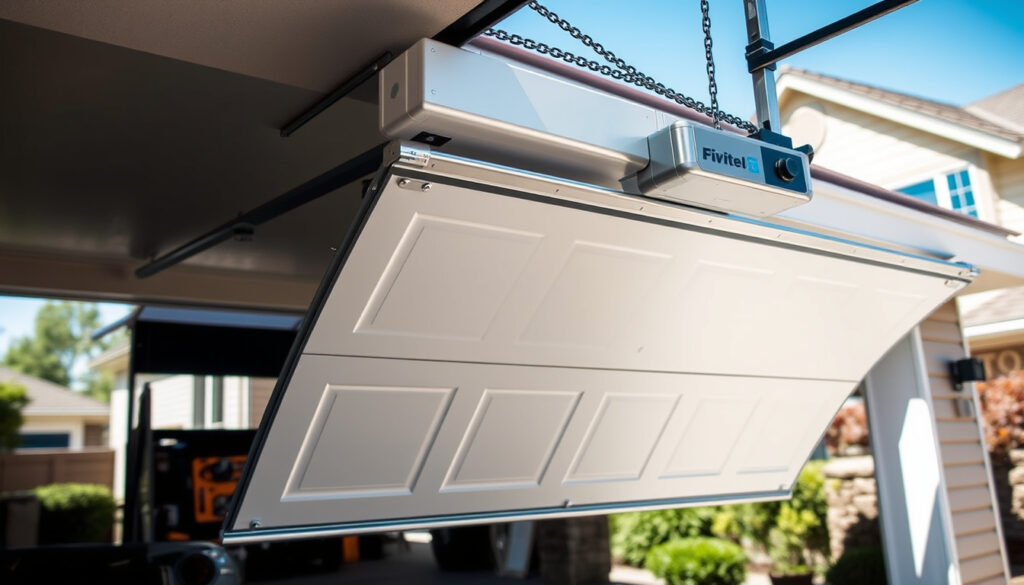
Tilt Garage Door Openers: Cost, Brands, Lifespan & Automation
If your garage has tight headroom or awkward side clearances, a standard roller or sectional door might not be an option. That’s where tilt garage doors come in — and automating one takes a bit more know-how than picking a regular garage door opener.
Average cost of a tilt garage door (installed): $2,000 – $5,000 AUD · Average lifespan of a garage door opener: 10–15 years · Most reliable opener brand (multiple sources): Chamberlain/Merlin · Tilt door automation success rate: High, with compatible opener kits widely available · Typical opener installation time (DIY): 2–4 hours
Quick snapshot
- Tilt garage doors are still manufactured and sold in Australia and New Zealand (hipages, Australian trade marketplace)
- Tilt doors can be automated using compatible openers from Merlin, Chamberlain, ATA, B&D, and Dominator (AUS Garage Door Parts, specialist supplier)
- Garage door openers typically last 10–15 years (hipages)
- Exact market share of tilt doors vs sectional doors in Australia/New Zealand — no publicly available data
- Precise failure rates of individual opener brands — no independent testing published
- Tilt door openers remain a stable niche category; no major product or technology shifts expected in 2025 (AUS Garage Door Parts)
- Smart home integration (Wi‑Fi, app control) is becoming standard on new opener models from Merlin and Chamberlain (Merlin, Australian opener manufacturer)
These specifications give you the baseline for what a tilt door opener needs to deliver.
| Attribute | Value |
|---|---|
| Door panel style | Single solid panel tilts outward/upward |
| Typical opener power | 600–1200 N (Newton) for residential use |
| Drive types available | Belt, chain, screw |
| Smart home compatibility | Yes (most new models support Wi‑Fi/app control) |
| Average installation time (DIY) | 2–4 hours |
Are tilt garage doors good?
Advantages of tilt garage doors for modern homes
- They are made from a single solid panel that pivots outward and upward in one smooth motion, according to Merlin (garage door opener specialist).
- Ideal for garages with restricted headroom or side space — no overhead tracks required.
- Modern tilt doors can be insulated and customised with windows, colours, and finishes.
- Counterweight and hydraulic options exist for larger or heavier doors.
Disadvantages of tilt garage doors
- Not ideal for very large or heavy custom doors without additional counterweight support.
- May require professional installation for hydraulic or swing‑out systems.
- Cost is generally higher than a basic roller door — hipages (Australian trade platform) notes tilt doors cost more than roller doors.
If your garage has less than 300mm of headroom, a tilt door is often the only automated option. Homeowners in older Aussie properties frequently face this constraint — a tilt door opener can unlock usable storage space that a track system would steal.
Do they still make tilt up garage doors?
Current availability of tilt garage doors
Yes — tilt garage doors are still manufactured and sold by major Australian and New Zealand brands like Steel‑Line, Merlin, and Dominator. hipages (trade quote platform) confirms they remain a common option in residential projects. Custom sizes and finishes are widely available.
Modern tilt door designs and materials
- Steel‑Line offers insulated tilt panels with timber‑look finishes.
- Dominator provides tilt doors with baked‑on enamel coatings for durability.
- Merlin’s product range includes tilt‑compatible opener kits designed specifically for single‑panel doors.
What this means: tilt doors are far from obsolete. They have simply become a niche product for specific garage configurations.
Many homeowners assume tilt doors are discontinued because sectional doors dominate new builds. But for renovations and older homes, tilt doors are often the only structural fit. Ignoring them means either expensive structural changes or losing garage storage space.
Can tilt garage doors be automated?
Compatible opener types for tilt doors
Yes — tilt garage doors can be automated with dedicated openers from Merlin, Chamberlain, ATA, B&D, and Dominator. AUS Garage Door Parts (specialist retailer) explains that tilt‑compatible openers use the same force‑rating principles as sectional openers.
Installation process for an automatic tilt garage door opener
- Disconnect manual door lock and ensure door moves freely.
- Assemble the opener rail according to the manufacturer’s instructions.
- Mount the opener to the garage ceiling using the provided brackets.
- Attach the door‑arm bracket to the tilt door panel.
- Connect the opener arm to the bracket and adjust travel limits.
- Install safety sensors and test auto‑reverse function.
DIY installation kits are available with clear instructions; typical time is 2–4 hours. hipages (trade platform) notes professional installation averages AUD 55 per hour and adds 4–6 hours of labour.
Not all openers are tilt‑door ready. A standard roller‑door opener may not have the correct travel length or force adjustment for a tilt panel. Always check compatibility — Merlin and Chamberlain sell specific tilt kits that avoid expensive returns.
What is the most reliable brand of garage door opener?
Merlin / Chamberlain reliability and features
Chamberlain (parent company of Merlin) is frequently cited as the most reliable brand. AUS Garage Door Parts (industry specialist) notes that Merlin openers are designed for quiet, smooth operation with strong warranty cover. Their belt‑drive models are particularly popular in residential settings.
Other reliable brands: ATA, B&D, Dominator
- ATA’s tilt openers feature soft‑start and soft‑stop technology.
- B&D (B&D Australia, manufacturer of garage doors and openers) offers openers from about AUD 850 to AUD 1,300.
- Dominator (Dominator, New Zealand garage door specialist) provides motors designed for quiet, reliable operation.
Before we compare openers, one pattern stands out: belt‑drive models from Merlin, Chamberlain, and Dominator all claim similar noise reduction and lifespan. The real differentiator is warranty length and smart‑home compatibility.
| Brand | Drive Type | Smart Features | Warranty | Price Range (AUD) |
|---|---|---|---|---|
| Merlin | Belt / Chain | Wi‑Fi, myQ app | 7 years (motor) | $400–$800 |
| Chamberlain | Belt / Chain | Wi‑Fi, myQ app | 7 years (motor) | $350–$750 |
| ATA | Belt / Screw | Wi‑Fi (select models) | 5 years (motor) | $350–$650 |
| B&D | Chain / Belt | Wi‑Fi on premium | 5 years (motor) | $850–$1,300 |
| Dominator | Belt | Wi‑Fi (app control) | 6 years (motor) | $400–$700 |
How much does a tilt garage door cost?
Price range for tilt garage doors (door only)
According to hipages (Australian trade platform), a single tilt garage door in Australia costs about AUD 1,700 to AUD 2,250, while a double tilt door ranges from AUD 2,200 to AUD 2,750. These figures exclude installation and automation.
Installation cost for a tilt garage door opener
- Opener hardware: AUD 400–$1,300 depending on brand and features.
- Professional installation labour: AUD 220–$330 (4–6 hr × $55/hr).
- DIY installation can save the labour cost but requires 2–4 hours of work.
ArchiPro (building resource platform) notes that overall garage door prices can range from AUD 600 to AUD 8,000+ because every installation is unique.
What is the average lifespan of a garage door opener?
Lifespan by drive type: belt, chain, screw
- Belt drive: 12–15 years with regular maintenance.
- Chain drive: 10–12 years (requires periodic lubrication).
- Screw drive: 10–14 years (less common in Australia).
hipages (trade platform) confirms the general range of 10–15 years for all types.
Signs it is time to replace your opener
- Grinding or chattering noise during operation.
- Door reverses without obstruction.
- Opener fails to respond to remote or wall switch.
- Safety sensors misaligned or worn.
Belt drives last longer and run quieter, but they cost AUD 100–$200 more than chain drives. For attached garages or homes with bedrooms above the garage, the upgrade is worth it. Detached garages can save money with a chain drive without sacrificing comfort.
Clarity check
Confirmed facts
- Tilt garage doors are still manufactured and sold in Australia and New Zealand.
- Tilt doors can be automated with compatible Merlin, Chamberlain, ATA, B&D, and Dominator openers.
- Garage door openers typically last 10–15 years.
What’s unclear
- Exact market share of tilt vs sectional doors in AU/NZ (no public data).
- Precise failure rates of individual opener brands (no independent testing published).
Tilt garage doors are made from a single solid panel that tilts outward and upward in one smooth motion.
All our sectional door motors are designed to operate quietly and quickly, and to open and close your garage door reliably for years to come.
For Australian homeowners weighing tilt vs sectional, the choice comes down to space and budget: if headroom is tight, a tilt door with a quality opener is still the smartest move — or risk losing precious storage space to overhead tracks.
Related reading
- Hot Water Cylinder Replacement: Costs, Signs & Lifespan Guide
- Interior Painters West Auckland: Costs, Paint & Hiring Tips
titaniumgaragedoors.com.au, wholesalegaragedoors.com.au, facebook.com
For those across the Tasman, garage door opener options in New Zealand offer a useful comparison of brands and installation costs.
Frequently asked questions
Can I use a regular garage door opener on a tilt door?
Not always. Many standard openers are designed for sectional or roller doors and may not have the correct travel range or force adjustment. Always check compatibility — tilt‑specific kits from Merlin or Chamberlain are recommended.
What size opener do I need for a tilt garage door?
Residential tilt doors typically require an opener with 600–1200 N of force. Check your door’s weight; heavier insulated doors may need a higher‑powered model.
Do tilt garage doors require special springs?
Yes — most tilt doors use torsion springs or counterweights. A professional should inspect spring tension before adding an opener, as incorrect tension can damage the mechanism.
Are tilt garage doors secure?
Yes, modern tilt doors include deadbolt locks and can be retrofitted with smart‑home security sensors. The single‑panel design is inherently more rigid than sectional doors, making forced entry harder.
Can I install a tilt garage door opener myself?
Yes — many kits come with DIY‑friendly instructions and quick‑connect hardware. Expect 2–4 hours for a first‑time install. Some steps (sensor alignment, force calibration) require careful attention to safety.
What maintenance does a tilt garage door opener need?
Lubricate moving parts every 6 months, test auto‑reverse monthly, and check that safety sensors are clean and aligned. Belt drives may need tension adjustment after the first year.
More related posts
 Sex on the Beach Cocktail: IBA Recipe, Ingredients & UK Tips
 Pacific Edge Share Price: Is PEB a Good Investment?
 Ryan Fox Latest News – 47th OWGR, Masters After Surgery
 Bed Bath & Beyond Richmond: Closure and Alternatives
 NZ Income Tax Calculator: See Your Real Take-Home Pay
 Valentino Born in Roma: What It Smells Like & Is It Worth It
 2025 NZ Golf Open: Dates, Venue, Prize Money & Winner