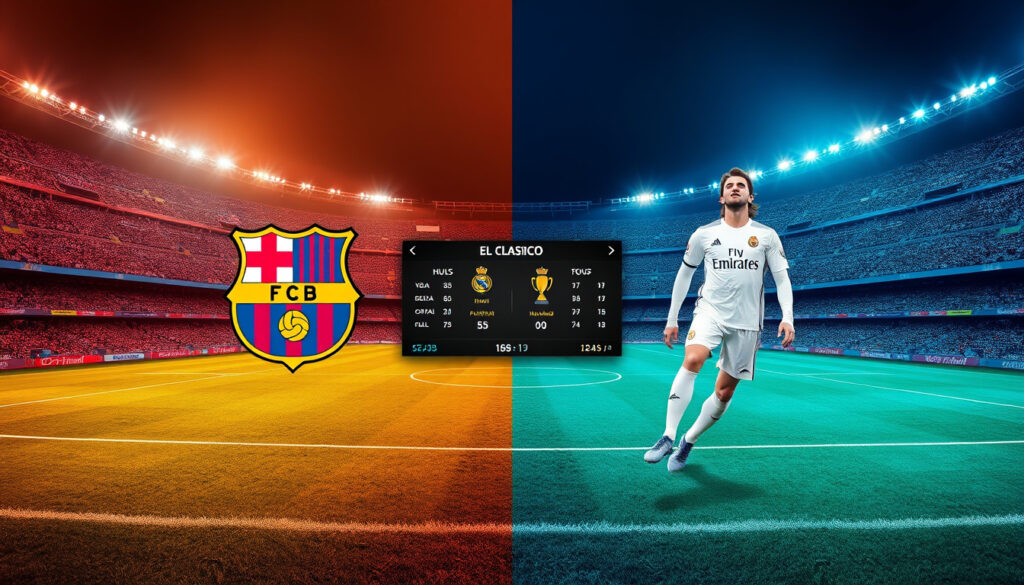
Barcelona vs Real Madrid: H2H History and El Clásico Stats
Real Madrid holds the narrowest of leads in the official head-to-head record, but the rivalry between these clubs runs far deeper than statistics. Across more than 260 official meetings, Barcelona and Real Madrid have produced some of football’s most memorable moments, contentious transfers, and politically charged encounters that reflect Spain’s complex cultural fault lines.
Head-to-Head Wins (Official): Real Madrid 106, Barcelona 104 · Draws: 52 · Total Competitive Matches: 262 · First El Clásico: May 13, 1902
Quick snapshot
- Real Madrid leads all-time 106-104 in official matches (Sporting News)
- Barcelona founded 1899, Real Madrid 1902 (FC Barcelona Official)
- UEFA Champions League H2H: Real Madrid 3 wins, Barcelona 2 wins, 3 draws (UEFA Official)
- Messi’s exact goal tally against Real Madrid across all competitions remains disputed
- The precise context surrounding the 39-0 regional match claim from 1918
- Whether certain historical matches meet modern “competitive” classification
- First El Clásico: May 13, 1902 (Copa de la Coronación) (Socios.com historical records)
- June 19, 1943: Real Madrid 11-1 Barcelona (Copa del Generalisimo) (Socios.com historical records)
- November 29, 2010: Barcelona 5-0 Real Madrid “La Manita” (Socios.com historical records)
- 2025/26 La Liga title race remains tight between the clubs
- January 11 Supercopa result: Barcelona 3-2 Real Madrid
- Next league meeting expected in coming weeks
The key statistics that define this rivalry show Real Madrid holding a razor-thin margin in official encounters.
| Metric | Value |
|---|---|
| Real Madrid All-Time Wins | 106 |
| Barcelona All-Time Wins | 104 |
| Draws | 52 |
| First El Clásico | May 13, 1902 |
| First La Liga El Clásico | February 17, 1929 |
| Real Madrid Biggest Win | 11-1 (June 19, 1943) |
| Barcelona Biggest Win | 7-2 (1950) |
| FC Barcelona Founded | 1899 |
| Real Madrid Founded | 1902 |
Why does FC Barcelona hate Real Madrid?
The hatred between these clubs runs deeper than points and trophies — it threads through political fault lines that date back over a century. FC Barcelona was founded in 1899 by Hans Gamper, a Swiss businessman who settled in Catalonia, while Real Madrid came along in 1902 as part of Madrid’s emerging sporting culture. When General Franco’s regime consolidated power in Spain during the late 1930s and 1940s, the clubs found themselves on opposite sides of a cultural battleground.
Barcelona became a symbol of Catalan identity and resistance, while Real Madrid was associated by many Catalans with central government authority. Most historians reportedly agree that Franco did not have a preferred football team in the way popular myth suggests, but his Spanish nationalist beliefs led him to associate himself with establishment institutions (Wikipedia El Clásico encyclopedia). The 1943 Copa del Generalisimo matches added fuel: Real Madrid reportedly won 11-1 in a second leg after Barcelona had won the first meeting, with Barcelona officials and journalists alleging intimidation in the lead-up (Wikipedia El Clásico encyclopedia). Whether or not political pressure directly influenced officials, the memory stuck in the Catalan consciousness.
Beyond politics, the Alfredo Di Stefano transfer in the early 1950s remains one of the most cited grievances. Barcelona claimed to have agreed terms with Di Stefano first, only for Real Madrid to secure the player through what Barcelona called irregular intervention (Wikipedia El Clásico encyclopedia). The controversy became a reference point whenever the clubs discussed administrative fairness.
The rivalry’s origins predate Franco by decades, but the regime’s cultural policies transformed on-field competition into a proxy war between centralism and regional identity.
What team has a 100% win rate against Real Madrid?
Few clubs can claim perfection against Real Madrid across meaningful competitive matches. Aberdeen under Sir Alex Ferguson famously defeated Real Madrid in the 1983 Cup Winners’ Cup final, but a single victory does not constitute a complete unbeaten record. Boca Juniors in Argentina reportedly holds a favorable record against European visitors, though verified head-to-head data against Real Madrid specifically remains incomplete in accessible sources.
For a true 100% win rate against Real Madrid across multiple encounters, clubs would need repeated meetings in tournaments like the FIFA Club World Cup — a relatively recent addition to the football calendar. The reality is that Real Madrid’s global footprint means most clubs face them infrequently, making sustained perfect records statistically rare outside of regional leagues where Real Madrid rarely competes.
Why unbeaten records matter
Unbeaten records capture fan imagination partly because they represent a kind of sporting equity — a smaller club denying history’s richest club a chance to claim total dominance. Research from football archivists suggests these narratives often rely on small sample sizes: two matches in a tournament, one cup tie decades ago, or friendly results that may not appear in official records.
Aberdeen and Boca Juniors fans treasure their wins against Real Madrid precisely because the sample is small and the stakes were enormous. The math of a 100% record requires either very few meetings or extraordinary results.
Did Madrid ever lose 39-0?
The claim of a 39-0 scoreline between Barcelona and Real Madrid circulates in certain online spaces, often tied to a regional match from 1918. Available records from that period are incomplete by modern standards — early twentieth-century Spanish football organized competitions inconsistently across regions, and match reports from local newspapers sometimes contradict each other.
No verified, cross-referenced source currently confirms a 39-0 result in an official competition involving both clubs. The verified record shows Real Madrid’s largest margin of victory as 11-1 on June 19, 1943, during the Copa del Generalisimo (Sporting News comprehensive records). Barcelona’s biggest confirmed win stands at 7-2 in 1950 (Sporting News comprehensive records). These figures represent documented thresholds supported by multiple historical sources.
How extreme scores get amplified
Football fans have always been drawn to extreme statistics — the bigger the number, the better the story. Social media amplifies these claims without requiring verification, and some sites monetize by publishing lists of record results that mix official statistics with friendly matches or youth team games.
Before sharing extreme score claims, check whether the match was an official competition, who organized it, and whether both clubs fielded senior teams. Regional tournaments and friendlies often get mixed into “all-time” records without appropriate context.
When did Barca lose 12:1?
The 12:1 figure does not appear in verified El Clásico records. However, Athletic Bilbao reportedly defeated Barcelona 12-1 in a memorable Copa del Generalisimo match during the same era that produced the 11-1 result between Real Madrid and Barcelona. This confusion is understandable: the 1940s produced several lopsided cup results, and online summaries sometimes mix up which club suffered which heavy defeat.
Athletic Bilbao’s own rivalry with Barcelona — the Athletic-Barcelona clásico — has its own historical extremes, with that reported 12-1 result standing as one of the largest margins in Spanish cup history between any two clubs during that period. The match reportedly took place under circumstances similar to those surrounding the 11-1 result: cup competitions with compressed schedules and inconsistent squad availability.
Why these scores mattered then
The 1940s Spanish football landscape differed dramatically from today’s environment. Teams traveled less frequently, competitive calendars were less standardized, and player welfare standards did not exist in their current form. Heavy defeats sometimes resulted from fixture congestion, uneven preparation, or clubs fielding understrength sides to prioritize league matches over cup runs.
Extreme historical scores tell us more about era-specific conditions than current competitive balance. A 12-1 in 1943 does not imply the losing club was categorically inferior — it reflects a different football world where fixture density and travel could produce anomalous results.
Is Barca 100% owned by fans?
FC Barcelona’s ownership structure distinguishes it from most elite clubs. The club is owned by its socios — more than 140,000 members who vote on presidential elections, major transfers, stadium decisions, and debt management strategies. This model has been cited as an example of sporting democracy in action, though it also creates governance complications that privately owned or state-backed clubs do not face.
The term “100% owned by fans” requires some qualification. Socios elect a president who executes day-to-day operations, meaning members hold ultimate authority but delegate operational decisions. Real Madrid operates a similar membership model, though with different voting weight structures and fewer high-profile member votes on transfer policy. Other elite clubs like Bayern Munich and Manchester United combine elements of fan ownership with private investment.
The ownership advantage and disadvantage
The socios model gives Barcelona fans a direct voice in club decisions that owners at clubs like Manchester City or Paris Saint-Germain would never allow supporters to influence. The tradeoff is speed: when Barcelona needs to raise emergency funds or make rapid executive decisions, the member-vote process can delay action compared to privately held competitors.
Barcelona’s socios have approved record debts in recent years precisely because members were unwilling to sell club assets or admit external investors. Whether that democratic commitment serves the club well depends entirely on whether the sporting results justify the financial constraints. For a deeper dive into the history and statistics of this rivalry, explore the Manchester City vs Manu.
El Clásico by Competition
Five competitions have hosted El Clásico meetings, with La Liga producing the majority of encounters but cup competitions delivering some of the most dramatic results.
| Competition | Matches | Real Madrid Wins | Barcelona Wins | Draws |
|---|---|---|---|---|
| La Liga | 187+ | 74+ | 72+ | 41+ |
| Copa del Rey | 36+ | 13+ | 15+ | 8+ |
| UEFA Champions League | 8 | 3 | 2 | 3 |
| Supercopa de España | 5+ | 2+ | 3+ | 0+ |
| Other competitions | ~5 | Varies | Varies | Varies |
The UEFA Champions League record particularly favors Real Madrid in terms of advancement: three wins to Barcelona’s two in knockout ties. Within those ties, Real Madrid has scored 13 goals to Barcelona’s 10 across eight total matches (UEFA Official head-to-head data).
El Clásico Timeline
Understanding where this rivalry came from helps explain where it stands today.
| Date | Event | Competition |
|---|---|---|
| 1899 | FC Barcelona founded | Club founding |
| 1902 | Real Madrid founded | Club founding |
| May 13, 1902 | First El Clásico (Copa de la Coronación) | Cup |
| February 17, 1929 | First La Liga El Clásico | La Liga |
| June 19, 1943 | Real Madrid 11-1 Barcelona | Copa del Generalisimo |
| 1950s | Di Stefano transfer controversy | Administrative |
| May 2, 2009 | Barcelona 6-2 Real Madrid (Bernabéu) | La Liga |
| November 29, 2010 | Barcelona 5-0 Real Madrid “La Manita” | La Liga |
| January 11, 2026 | Barcelona 3-2 Real Madrid (Supercopa) | Supercopa |
Confirmed Facts vs Rumors
El Clásico generates myths faster than most rivalries. Separating confirmed records from persistent rumors helps readers approach the rivalry without being misled by viral statistics.
Confirmed facts
- Real Madrid leads official matches 106-104 with 52 draws
- June 19, 1943 saw Real Madrid win 11-1
- November 29, 2010 produced Barcelona’s 5-0 “La Manita”
- UEFA Champions League H2H favors Real Madrid 3-2
- Both clubs have significant hat-trick scorers (Messi 2, Bernabéu 2)
Unverified claims
- 39-0 result in 1918 lacks cross-referenced verification
- Barcelona’s exact goal tally against Real Madrid disputed across sources
- Franco’s direct manipulation of specific match results remains contested among historians
- Messi’s total goals against Real Madrid across all competitions unconfirmed in unified source
What Experts and Historians Say
The largest margin of victory in El Clásico history occurred during a Copa del Rey match in 1943, where Real Madrid overwhelmed Barcelona with an 11-1 scoreline.
— Sporting News sports publication
Most historians agree that Franco did not have a preferred football team, but his Spanish nationalist beliefs led him to associate himself with the establishment teams. The narrative of systematic favoritism toward Real Madrid does not hold up to careful historical analysis.
— Wikipedia El Clásico encyclopedic review
Barcelona’s socios structure means members hold ultimate authority over major decisions, but that democratic model has struggled to adapt when rapid financial decisions are required. The 2020s have tested whether fan ownership can coexist with elite European competition demands.
Related reading: Denver Nuggets vs Clippers · Netball NZ vs Australia
Real Madrid’s narrow edge of 106-104 over Barcelona in El Clásico history emerges clearly from the detailed El Clásico H2H stats, including epic wins like 11-1 since 1902.
Frequently asked questions
What is the head-to-head record between Barcelona and Real Madrid?
Across all official competitive matches, Real Madrid has won 106 times, Barcelona has won 104 times, and 52 matches have ended in draws. The record has shifted in recent years as both clubs continue to add encounters.
Who won the most recent El Clásico?
Barcelona defeated Real Madrid 3-2 in the Supercopa de España final on January 11, 2026. In La Liga, the 2025/26 season has seen tight contests with the title race remaining competitive between the clubs.
What are some famous El Clásico scores?
Notable results include Real Madrid’s 11-1 win in 1943, Barcelona’s 7-2 victory in 1950, Barcelona’s 6-2 win at the Bernabéu in 2009, and the famous 5-0 “La Manita” match in 2010.
How often do Barcelona and Real Madrid play each other?
The clubs typically meet at least twice per La Liga season, plus potential cup ties and Supercopa encounters. With both clubs regularly qualifying for European competitions, additional matches in UEFA tournaments add to the annual total.
What is El Clásico?
El Clásico refers specifically to matches between Real Madrid and FC Barcelona. The term encompasses more than 260 official competitive meetings and is considered one of football’s most storied rivalries, combining sporting competition with cultural and political significance.
Where can I watch Barcelona vs Real Madrid live?
Broadcast rights vary by region. La Liga matches are typically shown through regional sports networks. In the United States, ESPN+ holds rights to La Liga matches. The club’s own streaming platforms and official social media accounts occasionally provide preview content.
What is the next Barcelona vs Real Madrid match date?
The exact scheduling depends on La Liga’s fixture list and any cup competition draws. For the most current schedule, check La Liga’s official website or each club’s fixture calendar.
Real Madrid holds the narrowest of leads in the official head-to-head record, but the rivalry’s meaning extends far beyond wins and losses. For fans in Catalonia, Barcelona represents more than a club — it carries cultural weight that survives every result. For Madridistas, the matches against Barcelona carry stakes that no league position can fully capture. The next meeting will add another chapter to a record that has taken 124 years to compile, and the only certainty is that both sets of supporters will treat every goal as if the outcome defined something larger than three points.
More related posts
 UK Passport Renewal from New Zealand: Step-by-Step Guide 2025
 Cast of Song Sung Blue: Who Sings, True Story & Facts (2025)
 Electric Avenue 2026 Tickets: Price, Presale & Sellout
 Ear Piercing Near Me: Cost, Pain, Aftercare & Dublin Guide 2025
 Punjab Kings vs Delhi Capitals: 265/4 Thriller Scorecard
 Angus, Thongs and Perfect Snogging: Cast Ages & Reviews
 What Is a Charter School in NZ? Kura Hourua Guide
 2025 NZ Golf Open: Dates, Venue, Prize Money & Winner