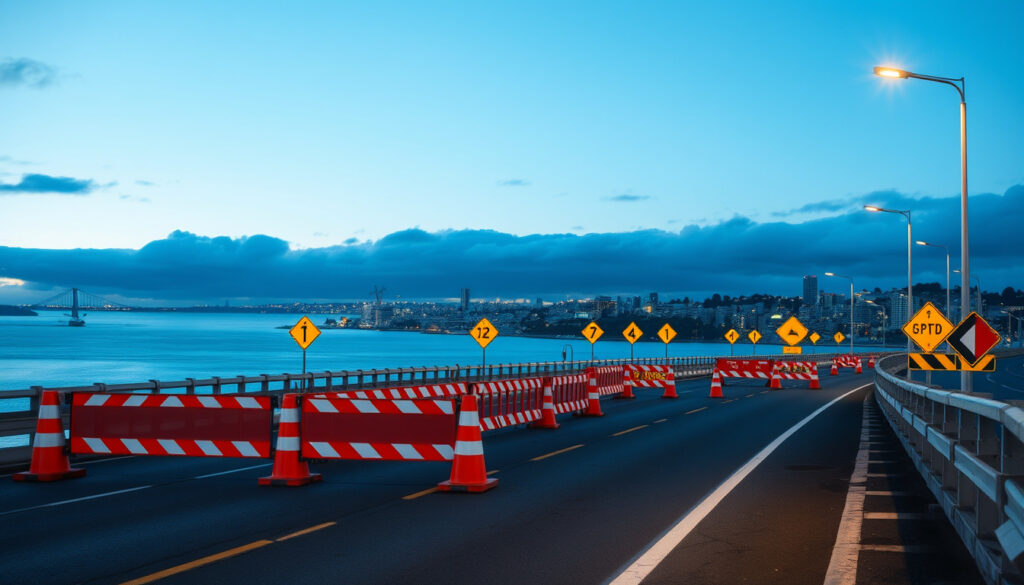
Auckland Harbour Bridge Closures: Current Status and Alerts
Drivers crossing the Auckland Harbour Bridge face a two-tier safety system where lane restrictions kick in at 75–85 km/h gusts and full closures lock out all traffic once winds hit 90 km/h. The NZ Transport Agency issues wind alerts dozens of times a year—sometimes closing lanes, sometimes shutting the whole bridge—and the rules that trigger those decisions are more precise than most drivers realize. Here’s what the data shows about how and why the bridge closes.
Operator: NZ Transport Agency Waka Kotahi · Key Closure Trigger: High winds and severe weather · Live Bulletin Site: journeys.nzta.govt.nz
Quick snapshot
- Gusts at 90 km/h trigger full closure (1News)
- NZTA monitors wind continuously via electronic sensors (Auckland Transport)
- Detour: SH16/SH18 western ring route (NZTA Journeys)
- Exact wind speed threshold for amber alert activation
- Frequency of full closures versus lane restrictions per year
- 25 March 2026: Strong winds bulletin issued with gusts up to 120 km/h (NZTA Journeys)
- Peak: 26 March 08:00 to 27 March 01:00 (NZTA Journeys)
- Overnight closures scheduled 28 March – 2 April 2026 (NZTA Journeys)
- Lane restrictions near Ramarama expected May–June 2026 (NZTA Journeys)
The key facts table below summarizes the operational thresholds NZTA uses to manage Auckland Harbour Bridge traffic during wind events.
| Label | Value |
|---|---|
| Operator | NZ Transport Agency Waka Kotahi |
| Key Closure Trigger | High winds and severe weather |
| Live Bulletin Site | journeys.nzta.govt.nz |
| Full Closure Threshold | 90 km/h gusts |
| Amber Alert Threshold | 75–85 km/h gusts |
| Recommended Detour | SH16/SH18 western ring route |
At what wind speed do they close the Auckland Harbour Bridge?
NZTA operates a two-tier alert system tied to specific gust measurements at the bridge deck. When wind gusts reach 75–85 km/h, an Amber Alert activates: the speed limit drops and outer lanes close to prevent sideswipes between high-sided vehicles and regular traffic. At 90 km/h, all lanes close because the bridge becomes unsafe for any vehicle and structural vulnerability to impacts rises sharply.
Crosswinds matter as much as the raw speed — MetService forecasts factor in wind direction, and perpendicular gusts trigger responses faster than headwinds of equal velocity. The NZTA Quick Guide details separate protocols for oblique versus perpendicular wind angles, with oblique winds often producing the more dangerous sideswipe conditions.
Wind thresholds from official sources
A 1News report confirmed the 90 km/h full-closure threshold directly from NZTA positioning. The agency stated that when gusts hit that level, “we close all lanes because it’s unsafe for any vehicle to be on the bridge and the bridge structure is vulnerable to vehicle impacts.” For the amber tier, NZTA bulletins reference the 75–85 km/h band as the point where lane restrictions and speed reductions begin.
Historical wind-related closures
NZTA’s media archive shows wind warnings issued on 19 August 2024 and 28 October 2025 — demonstrating that severe gust events occur multiple times per year. The March 2026 bulletin, published at 15:18 on 25 March, warned of gusts up to 120 km/h, with peak intensity forecast between 26 March 08:00 and 27 March 01:00.
The pattern here shows NZTA prioritizes preventing vehicle-bridge impacts over maintaining traffic flow, which explains why the amber tier cuts speeds even before full closure.
Is Auckland Harbour Bridge open?
Check the NZTA Journey Planner for real-time status during active wind events. The agency updates electronic message boards along the motorway approach and publishes bulletins at journeys.nzta.govt.nz as conditions change.
Live status check
NZTA provides multiple channels for current bridge status: the Journey Planner portal, My Journeys email alerts, and the 0800 4 HIGHWAYS phone line. Electronic signs upstream of the bridge approach display lane closures and speed reductions in real time, so even if you’re already on the network, you may see updated restrictions before you reach the bridge.
Today and tomorrow updates
For the 25–27 March 2026 event, NZTA published a bulletin at 15:18 on 25 March warning of strong winds from 9pm that evening through 9am 27 March. Peak gusts of 120 km/h were forecast for the window from 26 March 08:00 through 27 March 01:00. Motorists planning travel during those hours should verify status immediately before departure.
The bridge can close with little warning when gusts spike. For morning or evening commutes during active wind watches, check NZTA Journey Planner before you leave — not after you’re already on the motorway.
Motorists who check the Journey Planner before departure avoid the dead-end scenario of reaching the bridge approach only to find all lanes blocked.
Is it safe to drive in Auckland today?
Wind alerts don’t mean the roads are dangerous by default — they mean conditions require adjusted behavior. When NZTA issues an amber alert, outer lanes close and speeds drop, giving motorists more time to react. High-sided vehicles and motorcyclists face the greatest risk from crosswinds, which can push them into adjacent lanes.
Weather impacts on bridge
Auckland Transport and NZTA monitor wind levels and directions continuously at the bridge. High winds can blow debris onto roads, exacerbating risks beyond the bridge itself. When gusts exceed 90 km/h, the full closure eliminates bridge-crossing risk entirely — but the detour via SH16/SH18 also introduces motorway driving in potentially windy conditions.
Driving conditions forecast
For the March 2026 event, NZTA explicitly advised high-sided vehicles and motorcyclists to avoid the bridge and use the western ring route. Bus routes crossing the bridge may face delays or cancellations during closures, affecting public transport options. Debris from high winds can be blown onto roads throughout the Auckland network, not just at the bridge.
Wind-related bridge closures are typically short-duration — lasting until gusts subside — but the ripple effects on the wider Auckland network can persist for hours after the bridge reopens. Plan accordingly if you have time-sensitive travel.
Drivers should treat amber alerts as a cue to reconsider high-sided vehicle trips, since the risk of crosswind-related sideswipes peaks before full closure.
What is the latest Auckland Harbour Bridge update?
The most recent alert as of this article covers 25–27 March 2026: strong winds with gusts up to 120 km/h, peak intensity 26 March 08:00 through 27 March 01:00. NZTA published this bulletin at 15:18 on 25 March, giving commuters roughly six hours of advance notice before the onset window.
Today live updates
Real-time status comes from NZTA Journey Planner, which aggregates bulletins and sensor data. The agency coordinates with MetService for wind forecasts, so bulletin timing reflects both current readings and anticipated changes. Electronic signs upstream advise of lane closures and speed limits in real time.
Upcoming closures
Beyond the March wind event, overnight motorway closures are scheduled from 28 March through 2 April 2026. Lane restrictions and full closures near Ramarama are expected during May–June 2026. These scheduled maintenance windows are separate from weather-driven alerts and appear in the Auckland region bulletins list alongside wind advisories.
Commuters should distinguish between weather-driven alerts and planned maintenance—these operate independently and require separate monitoring.
What causes Auckland Harbour Bridge closures?
Wind is the dominant cause, but not the only one. Weather events — severe gusts, thunderstorms, flooding — can trigger closures directly or by creating hazardous debris on the road. Maintenance and events like the Auckland Marathon can also require lane restrictions, though these are typically announced in advance.
Weather events
Severe wind gusts are the primary closure trigger. NZTA’s operational mandate includes protecting both traffic on the bridge and the structural integrity of the bridge itself during wind events. The 2020 bridge incident, which involved costly repairs, prompted stricter wind protocols. Amber and red alert thresholds exist precisely to prevent structural stress or vehicle crashes before conditions worsen to a full closure.
Maintenance and events
Scheduled maintenance like the overnight closures from 28 March – 2 April 2026 and the upcoming lane restrictions near Ramarama (May–June 2026) may involve partial lane reductions rather than full closures. Event-based restrictions, such as marathon lane closures noted on the Auckland Marathon website, are typically short-term and flag-managed.
Confirmed
- Winds at 90 km/h trigger full closure per 1News and NZTA bulletins
- Amber alerts activate at 75–85 km/h with lane and speed adjustments
- Overnight closures scheduled 28 March – 2 April 2026 per journeys.nzta.govt.nz
Unclear
- Exact operational threshold at which amber alert formally triggers
- Historical frequency of full closures versus lane restrictions per year
Weather closures differ fundamentally from maintenance restrictions—the former can impose full shutdowns within minutes, while the latter follow published schedules with advance notice.
Timeline
The timeline below tracks major Auckland Harbour Bridge wind-related events and scheduled maintenance through mid-2026.
| Date | Event |
|---|---|
| 25 March 2026 | Strong winds bulletin issued, 15:18 NZT. Gusts up to 120 km/h forecast from 21:00 |
| 26 March 2026 | Peak wind period begins, 08:00 |
| 26–27 March 2026 | Peak intensity window: 26 March 08:00 through 27 March 01:00 |
| 27 March 2026 | Winds expected to subside by 09:00 |
| 28 March – 2 April 2026 | Overnight motorway closures scheduled |
| May–June 2026 | Lane restrictions and potential full closures near Ramarama |
If you’re planning travel for 26 March, monitor NZTA Journey Planner and MetService forecasts that morning. Peak gusts of 120 km/h during an active commute window could trigger restrictions with little warning beyond electronic message boards.
Quotes
When wind gusts reach 90km/h, we close all lanes because it’s unsafe for any vehicle to be on the bridge and the bridge structure is vulnerable to vehicle impacts.
— NZTA (transport agency statement via 1News, October 2025)
Drive to the conditions and pay attention to electronic message boards.
— NZTA (motorist advisory via NZTA Journeys bulletin, March 2026)
NZTA has a responsibility to protect traffic on and around the Auckland Harbour Bridge and the structural integrity.
— NZTA (official statement via NZTA real-time operations page)
Summary
NZTA manages Auckland Harbour Bridge closures through a calibrated wind-response system: amber alerts at 75–85 km/h restrict lanes, full closure at 90 km/h. For commuters and logistics operators, the practical takeaway is straightforward — monitor NZTA Journey Planner before any bridge crossing during an active wind watch, and if you’re driving a high-sided vehicle or motorcycle, treat gusts above 75 km/h as your cue to take the western ring route. The March 2026 event demonstrates how quickly conditions can escalate: a 120 km/h forecast means peak-intensity hours could trigger restrictions with little warning beyond electronic message boards.
Related reading: Harbour Bridge closures and live status · Truck driver jobs in Auckland
journeys.nzta.govt.nz, journeys.nzta.govt.nz, nzta.govt.nz, nzta.govt.nz, youtube.com
Frequently asked questions
What should I do during Auckland Harbour Bridge closures?
Use the SH16/SH18 western ring route. NZTA advises checking electronic message boards for real-time updates and driving to conditions when lanes are restricted but the bridge remains open.
How often are there Auckland Harbour Bridge closures?
Wind warnings appear multiple times per year, with documented alerts from August 2024, October 2025, January 2026, and March 2026. Exact closure frequency varies by weather patterns.
What is the Auckland Harbour Bridge update tomorrow?
Check NZTA Journey Planner for the latest bulletins. Active alerts are updated in real time as conditions change.
Are there detours for Auckland Harbour Bridge closures?
Yes. NZTA designates the SH16/SH18 western ring route as the primary detour. This adds travel time but avoids the bridge’s wind exposure.
Why was the Auckland Harbour Bridge closed recently?
Recent closures tied to wind events. The 25–27 March 2026 bulletin warned of gusts up to 120 km/h, with peak intensity 26 March 08:00 through 27 March 01:00.
How to get Auckland Harbour Bridge closures map?
NZTA Journey Planner displays real-time traffic conditions. The Auckland region bulletins page at journeys.nzta.govt.nz lists all current and upcoming alerts for the area.
What weather causes Auckland Harbour Bridge closures?
Severe wind gusts are the primary trigger. The two-tier system activates lane restrictions at 75–85 km/h and full closure at 90 km/h. Thunderstorms and flooding can also lead to restrictions.
More related posts
 Wheel Alignment Cost NZ: Prices, Signs & When to Get It Done
 Mitre 10 Trade Hub: Login, Benefits & SmartMate Guide
 How Much Protein Do I Need – Calculator Charts and Guide
 The Warehouse Group Careers: Jobs, Pay & Interview Tips
 Where to Find Free Templates for Word, Canva, and More
 US Immigration and Customs Enforcement: Powers, Detention, Rights
 Oaks Sydney Goldsbrough Suites: 4-Star Heritage Hotel