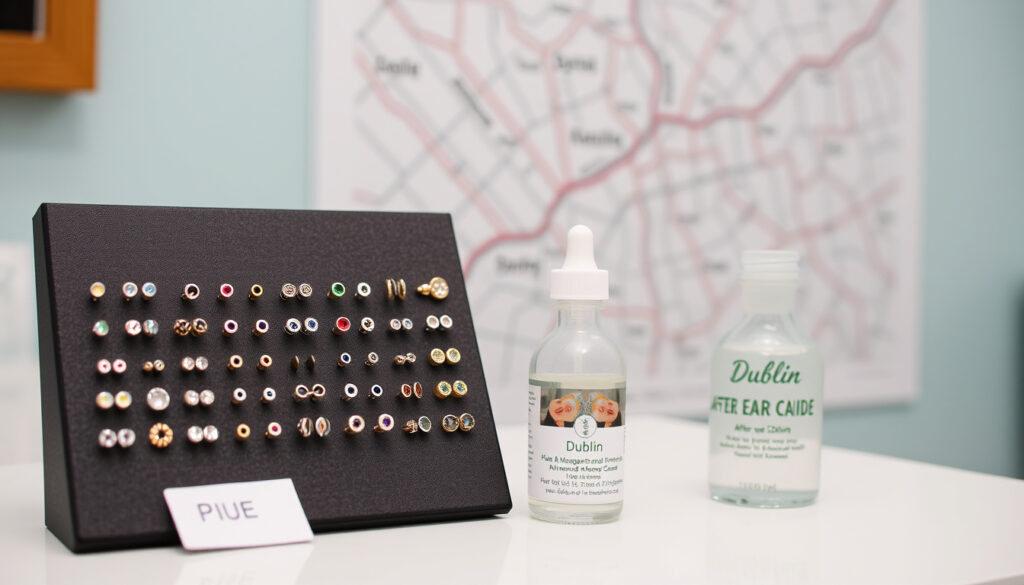
Ear Piercing Near Me: Cost, Pain, Aftercare & Dublin Guide 2025
You’ve probably spent a good five minutes scrolling Google Maps for “ear piercing near me” and ended up more confused about the price than when you started. The truth is, where you get pierced — whether you’re in Dublin or the US — changes not just the cost, but the healing timeline and the whole experience.
Average cost of a standard earlobe piercing in the US (2025): $30–$50 ·
Average cost of a standard earlobe piercing in Dublin, Ireland: €20–€40 ·
Most painful piercing (consensus from multiple sources): Industrial piercing ·
Healing time for an earlobe piercing: 6–8 weeks
Quick snapshot
- Standard earlobe: $30–$50 / €20–€40 (Wildcat Ink (Dublin piercing studio price list))
- Cartilage: $40–$80 / €30–€60 (Banter (US piercing studio service fee info))
- Includes jewelry and aftercare kit at some studios (Ulta Beauty (US beauty retailer piercing pricing))
- Industrial: most painful (consensus from multiple piercing pain surveys)
- Daith: very painful
- Snug: extremely painful
- Earlobe: least painful
- Earlobe: 6–8 weeks (American Academy of Dermatology (dermatology professional society))
- Cartilage: 3–12 months (American Academy of Dermatology (dermatology professional society))
- Daith: 6–12 months (American Academy of Dermatology (dermatology professional society))
- PIERCED Dublin: walk-ins accepted (PIERCED (Dublin piercing studio statement on Instagram))
- Walk-ins subject to piercer availability (PIERCED (Dublin piercing studio statement on Instagram))
- Appointments recommended for complex or multiple piercings (PIERCED (Dublin piercing studio statement on Instagram))
Here are the key numbers you need, side by side: cost, pain, and healing times across both markets.
| Feature | US (standard) | Ireland / Dublin (standard) |
|---|---|---|
| Standard earlobe piercing cost | $30–$50 (Ulta Beauty (US beauty retailer piercing pricing)) | €20–€40 (see Wildcat Ink above) |
| Cartilage piercing cost | $40–$80 (see Banter above) | €30–€60 (Maria Tash Dublin (high-end piercing studio Dublin)) |
| Most painful | Industrial | Industrial |
| Healing time earlobe | 6–8 weeks (see AADA above) | 6–8 weeks |
| Walk-ins at PIERCED Dublin | N/A | Yes (subject to availability) (see PIERCED above) |
The pattern: US chain studios often bundle jewelry, while Dublin studios separate fees — a distinction that changes the total you’ll pay.
How much is a normal ear piercing?
The answer depends entirely on which country you‘re in, what type of piercing you want, and whether the quoted price includes jewelry or aftercare. Let’s break it down.
Earlobe piercing cost range
- US: $30 to $50 for the service fee, plus jewelry. Ulta Beauty (US beauty retailer piercing pricing) charges $40 for a single piercing, which includes a hypoallergenic earring and aftercare solution. Banter (US piercing studio service fee info) charges between $35 and $60 for the service alone.
- Ireland: €20 to €40. Wildcat Ink (Dublin piercing studio price list) lists lobe piercings at €25, while Maria Tash Dublin (high-end piercing studio Dublin) charges a €20 service fee for earlobe piercings, with jewelry sold separately.
Cartilage piercing cost range
- US: $40 to $80. Sarah & Sebastian (designer piercing brand) lists cartilage piercings starting at $70-90, excluding jewelry, while Banter (US piercing studio service fee info) charges between $35 and $60.
- Ireland: €30 to €60. Wildcat Ink (Dublin piercing studio price list) charges €40 for all cartilage ear piercings.
What influences the price?
Jewelry quality, studio reputation, and location are the three biggest factors. Impulse BioWorks & Piercing (Dublin piercing studio) notes that one studio may list a lobe piercing at €15 but exclude jewelry, while another charges €25 with jewelry included. The same logic applies in the US — a bargain price often means you‘re paying extra for the earring separately.
The implication: comparing sticker prices without asking about jewelry inclusion leads to inaccurate budgets.
Cheaper studios often use piercing guns (which can traumatise cartilage), while more expensive studios use single-use, sterile needles. The Cleveland Clinic (healthcare provider) recommends needle piercings for cartilage — so if you‘re getting a helix or daith, the extra few euros for a studio that uses needles is money well spent.
What this means: the upfront cost difference is often a proxy for safety and quality.
What is the 2 3 rule for ear piercings?
The 2:3 ratio rule is an ear-curation principle used by piercing specialists to balance multiple piercings visually.
Understanding the 2:3 ratio
- The rule proposes that the visual distance between piercing positions should follow a 2:3 proportion for harmony — for example, the gap between a lobe and a mid-helix hole should be roughly 2:3 relative to the gap between that same helix and a forward helix.
- It‘s a guideline, not a strict requirement, but it’s commonly cited by ear curation specialists to avoid a “scattered“ look when planning 3 or more piercings on one ear.
Applying the rule for balanced ear curation
If you‘re planning an ear stack (multiple piercings on one ear), the 2:3 rule helps you decide spacing. Start with the lobe piercing — that’s your anchor point — and measure the distance between lobe and a potential helix hole. The next piercing (say, a mid-helix or tragus) should sit at roughly 1.5x that first distance from the lobe. Think of it like a staircase: each step is slightly wider than the last, not random dots.
The catch: without a visual guide, the rule is hard to apply precisely — ask your piercer to mark positions before committing.
What should I do before an ear piercing?
Preparation is about managing the procedure itself — and avoiding something as avoidable as fainting because you skipped breakfast.
Pre-piercing checklist
- Eat a meal beforehand — low blood sugar from skipping food is the most common reason people feel lightheaded during a piercing.
- Avoid alcohol and blood-thinning medications (like aspirin or ibuprofen) for 24 hours before the appointment. Alcohol thins the blood and can make the area bleed more during the piercing.
- Wear comfortable clothing with easy access to your ears (e.g., button-down shirt or hair tied back).
- Arrive with clean skin — no heavy makeup or lotion on the ears.
Choosing a reputable studio
- Confirm the studio uses single-use, sterile needles (not a piercing gun). The American Academy of Dermatology (dermatology professional society) recommends needle piercings for all cartilage piercings.
- Check the piercer‘s credentials — ask about their training, how long they’ve been piercing, and whether they are a member of a professional association (e.g., APP in the US).
- Read reviews on Google Maps or Yelp, focusing on hygiene and aftercare support.
Questions to ask your piercer
- What type of metal is the starter jewelry? (Implant-grade titanium or 14k gold preferred.)
- Is the price inclusive of jewelry and aftercare products?
- Do you offer a free downsize appointment? (Some studios like Sarah & Sebastian include one.)
“Leave jewelry in a new piercing for six weeks or more, even at night.”
— American Academy of Dermatology
The pattern: thorough preparation reduces the risk of complications and ensures you get the service you pay for.
What are the do’s and don’ts after ear piercing?
Healing is where most people trip up. Follow these guidelines to avoid infection and achieve a smooth recovery.
Aftercare do’s
- Wash hands before touching the piercing.
- Clean with saline solution twice daily — front and back. Cleveland Clinic (healthcare provider) recommends this routine.
- Leave the jewelry in for the full healing period (6–8 weeks for lobes, 3–12 months for cartilage).
- Use a clean paper towel to dry the area.
Aftercare don’ts
- Do not use hydrogen peroxide or antibacterial soaps — they can irritate the healing tissue. (AADA warning.)
- Do not rotate the jewelry — that is no longer recommended. (Cleveland Clinic.)
- Do not swim in pools, hot tubs, or open water until the piercing is fully healed.
- Do not change the jewelry yourself before the piercer says it’s safe.
Signs of infection to watch for
- Soreness, redness, swelling, or yellowish discharge — these can indicate infection. (AADA.)
- If you suspect infection, contact your piercer or a healthcare provider immediately.
“Walk-ins? Always yes! Don’t stress if you didn’t book.”
— PIERCED Dublin (Instagram announcement)
The implication: aftercare compliance is the single biggest factor in healing time and outcome.
Do pierced do walk-ins?
PIERCED, a popular Dublin studio with locations on Camden Street and in Tallaght, welcomes walk-ins.
Walk-in policy at PIERCED Dublin
- Walk-ins are accepted at both locations, subject to piercer availability.)
- Appointments are recommended for complex piercings (e.g., industrial, daith) or if you want multiple piercings in one session.
Walk-in vs appointment: pros and cons
Upsides of walk-ins
- Flexible — no need to plan ahead.
- Good for simple lobe piercings.
- Can check the studio vibe before committing.
Downsides of walk-ins
- May wait a long time if the piercer is busy.
- Not ideal for complex or multiple piercings.
- Less time to discuss aftercare and jewelry options.
The catch: walk-ins give you spontaneity, but booking an appointment ensures you get the piercer’s full attention.
What are the top 3 most painful piercings?
Pain is subjective, but certain ear piercings consistently rank higher in discomfort due to thicker cartilage and nerve density.
Industrial piercing
This piercing goes through two points on the upper ear cartilage, often with a single barbell. The double cartilage puncture and the pressure of the bar make it the most painful ear piercing. Healing can take 6–12 months.
Daith piercing
The daith sits in the innermost cartilage fold of the ear. It’s very painful because the cartilage here is thick and the area is sensitive. Many people also report a loud “crunch” sound during the piercing.
Snug piercing
The snug is placed through the anti-helix—the raised ridge opposite the helix. It’s extremely painful because it requires piercing through a thick piece of cartilage that is often hard to clamp.
Pain management tips
- Breathe deeply and slowly during the piercing.
- Eat beforehand to maintain blood sugar levels.
- Avoid topical numbing creams — they can interfere with the piercer’s accuracy and are not generally recommended.
The pattern: cartilage piercings hurt more than lobes, and the industrial consistently tops the pain charts.
What is a lady Diana piercing?
The Lady Diana piercing is a high earlobe piercing made famous by Princess Diana in the 1980s and 1990s.
Origin of the Lady Diana piercing
Princess Diana often wore small pearl or diamond studs high on her earlobe, just above the standard lobe piercing position. This placement became known as the “Lady Diana piercing” and is now a popular choice for a classic, elegant look.
Placement and jewelry style
- The piercing sits about 1–2 cm above the standard lobe hole, on the fleshy part of the earlobe.
- It is typically styled with a small, single stone stud (diamond, pearl, or gemstone).
- Healing time is similar to a standard lobe piercing: 6–8 weeks.
The implication: if you want a timeless, understated look, the Lady Diana piercing is a safe bet — and it’s one of the least painful options.
Related reading: ear piercing pricing · ear piercing age limit
For a detailed breakdown of costs and safety standards, check out this guide to Dublin ear piercing prices and studios.
Frequently Asked Questions
Can I get my ears pierced at a pharmacy?
Some pharmacies offer ear piercing, often using piercing guns. However, Cleveland Clinic (healthcare provider) recommends needle piercings for cartilage, and guns can cause more trauma. For lobes, pharmacy piercings are generally safe, but check that the technician is trained and uses sterile equipment.
Is it safe to get ears pierced with a gun?
Piercing guns are not recommended for cartilage because they can shatter the cartilage and cause more scarring. For earlobes, guns are widely used but carry a higher risk of infection if not properly sterilized. The American Academy of Dermatology (dermatology professional society) advises against guns for cartilage piercings.
How long after ear piercing can I sleep normally?
For lobe piercings, you can sleep normally after 6–8 weeks, but avoid sleeping on the piercing side for the first few weeks. For cartilage piercings, it may take 3–6 months before you can sleep on that side without discomfort. Use a travel pillow or donut pillow to keep pressure off the piercing.
Which ear should I pierce first?
There is no medical preference. Many people start with the left ear if they are right-handed, as the right hand is used for cleaning. Some cultures have traditions about which ear is pierced first, but it’s purely personal. Choose the ear you feel most comfortable with.
Can I fly after getting an ear piercing?
Yes, you can fly, but be aware that cabin pressure changes can cause slight discomfort in a fresh piercing, especially if it’s in the cartilage. Bring saline spray to clean the area after the flight. No restrictions otherwise.
Are there any age restrictions for ear piercing?
Age restrictions vary by studio and country. In Ireland, many studios require parental consent for under-16s; some require a parent to be present. In the US, studios often set a minimum age of 5–10 for lobe piercings. The Ink Factory (Dublin piercing studio) states that ear piercings require a minimum age of 15, with parental ID for flat and helix piercings. Always check the studio’s policy before booking.
This guide equips US and Dublin readers with the real numbers and aftercare rules to make an informed decision — whether you choose a walk-in at PIERCED or a booked appointment at a premium studio, the key is knowing what’s included in the price and how to care for the piercing afterward.
More related posts
 Keno Result Today Live – NZ Winning Numbers
 Key Lime Pie Recipe: Classic, No-Bake & Celebrity Variations
 USD to NZD Converter: Live Rate & Best Tools
 No 1 Shoes NZ: Locations, Deals & Shoe Guide
 Jonathan Bailey Movie and TV Show : Complete Filmography Guide
 Maui Jim Sunglasses NZ: Stockists, Prices & Reviews
 Currency Converter US to NZ: Live Rates & Fee Comparison
 How to Pair AirPods to Android: Step-by-Step Guide (2025)