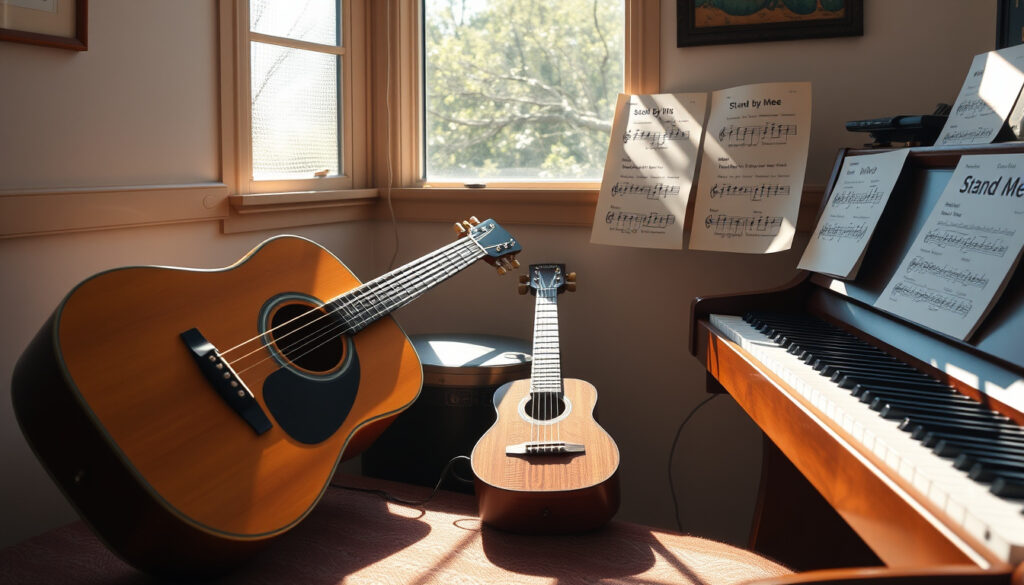
Stand By Me Chords: Guitar, Ukulele, Piano, Easy & Oasis
Few songs have the staying power of “Stand By Me.” Four chords—G, Em, C, and D with a capo on the 2nd fret—hand you the entire song. This guide breaks down every version worth knowing so you can start playing today.
Original Artist: Ben E. King · BPM: 120 · Common Capo: 2nd fret · Key with Capo: G · Basic Chords: G, Em, C, D
Quick snapshot
- Guitar version uses G Em C D with a capo on the 2nd fret (Ultimate-Guitar)
- Ultimate-Guitar version carries a 4.8/5 rating from 8,240 users (Ultimate-Guitar)
- Exact chord voicings used in the John Lennon cover version (YouTube Tutorial)
- Whether the Oasis version uses a barre-chord technique in the B7 transition (YouTube Tutorial)
- The original sheet music was published by artists Ben E. King, Jerry Leiber, and Mike Stoller (Original sheet music PDF)
- Sheet music archives show a version on UkuleleGo uploaded in January 2015 (Original sheet music PDF)
- Choose your instrument and key to match your skill level and vocal range
- Practice the intro progression before tackling the full song structure
The key facts table below summarizes the essential details for learning “Stand By Me” across instruments.
| Detail | Value |
|---|---|
| Original Release | 1961 |
| Genre | R&B / Soul |
| Common Key | A (no capo) |
| Guitar Chords | G, Em, C, D (capo 2nd fret) |
| Difficulty | Beginner |
| Time Signature | 4/4 |
| Sheet Music Arrangements | 109 (MusicNotes) |
| Songwriters | Ben E. King, Jerry Leiber, Mike Stoller |
Stand By Me Chords by Ben E. King
The classic Ben E. King recording lives in the key of A, but most guitar tutorials transpose the song down to G using a capo on the 2nd fret. That move brings the chords within easy reach for beginners while keeping the original vocal register intact. Ultimate-Guitar lists the arrangement as “Absolute Beginner” difficulty with a 4.8/5 rating from over 8,000 user reviews.
Intro and Verse Chords
The verse follows a straightforward four-chord loop. Place a capo at the 2nd fret and work through the following sequence:
- G — down strum for one measure
- Em — down strum for one measure
- C — down strum for one measure
- D — down strum for one measure
Repeat this pattern through each verse line. The timing is forgiving enough that you can sync it to the lyrics without rigid counting. Multiple tutorial sources confirm this progression appears in virtually every beginner-friendly version of the song.
Chorus Progression
The chorus uses the same four chords but with a slightly different rhythmic feel. Instead of the steady one-measure-per-chord pattern, the chorus calls for a syncopated down-up motion that adds momentum. Strum the G a beat longer, then shift quickly through Em and C before landing on D for the resolution.
Capo and Key Details
The capo effectively raises the key from A to G. Without a capo, you would play A, Bm, F#m, and G# in the original key. The 2nd-fret capo position is the most common recommendation across tab platforms and tutorial videos. You can experiment with higher capo positions to match a singer’s range, but the 2nd fret is the standard starting point.
If you only learn four chord shapes—G, Em, C, and D—you can play the entire Ben E. King version of “Stand By Me.” Those four shapes transfer across the guitar neck with a capo, giving you flexibility for any vocalist.
Stand By Me Oasis Chords
The Oasis cover takes the song in a rock-oriented direction, trading the soulful R&B feel for a cleaner, guitar-driven texture. The chord progression shifts to accommodate the band’s signature sound, and the B7 chord appears as a distinguishing feature that sets it apart from the original.
Intro Riff
The Oasis introduction uses a G-B7-C-D sequence rather than the simpler G-Em-C-D of the original. This minor variation introduces the B7 chord early, giving the arrangement a more angular harmonic profile. If the B7 feels stretchy, practice the shape separately before incorporating it into the full progression.
Verse and Chorus
The verse continues with G-B7-C-D, maintaining the stronger pull toward the dominant chord. The chorus follows the same progression with a heavier strumming intensity to match the band’s recording style. Acoustic covers often soften the B7 by substituting a simplified bar chord version or a two-finger shape.
Acoustic Variation
For acoustic performances, many players drop the B7 and return to the G-Em-C-D progression used in the Ben E. King arrangement. This compromise preserves the Oasis feel while keeping the chords beginner-friendly. YouTube tutorial channels show both approaches, with bar-chord and simplified versions available side by side.
The Oasis version shows how a single chord substitution—B7 instead of Em—reframes the harmonic mood from soul to rock without requiring a completely different technique set.
Stand By Me Chords Piano
Piano arrangements adapt the guitar chord shapes into left-hand voicings and right-hand melodic fills. MusicNotes reports over 109 sheet music arrangements available for piano, voice, guitar, and more than 50 other instruments, giving you plenty of options across skill levels. The easiest approach is to map the guitar chord shapes directly to piano keys and build from there.
Right Hand Melody
The melody follows the vocal line of the original recording. Piano tutorials suggest starting with the vocal melody in the right hand while maintaining the chord progression underneath. Begin with simple block chords in the left hand until you feel comfortable with the harmonic movement.
Left Hand Chords
Map the four core chords to piano voicings: G major, E minor, C major, and D major. The left hand can use root-position triads for beginners or move to inversions as you develop fluidity. Inversions reduce hand movement and help maintain continuity during longer phrases.
Full Arrangement
A full piano arrangement adds rhythmic patterns, fills, and dynamics that go beyond the basic chord shapes. MuseScore offers free lead sheets that show the complete structure, including chord symbols and melody notation. Start with the simple version, then layer in ornamental runs and dynamic changes as you progress.
Piano players who learn the left-hand chord voicings first develop a harmonic foundation that makes adapting any future arrangement faster. The four-chord core here is the same foundation used across guitar and ukulele versions.
Stand By Me Ukulele Chords
The ukulele is arguably the friendliest instrument for tackling “Stand By Me.” Most tutorials agree on a four-chord progression in the key of C: C, Am, F, and G. This transposition puts the song entirely within the top four frets of the soprano ukulele, making it ideal for beginners who want to play along with the original recording.
Basic Strumming Pattern
Begin with a simple down-up pattern: one down stroke per beat for the verse, switching to a syncopated down-up-down-up during the chorus. The 4/4 time signature keeps the rhythm predictable. Many tutorial videos show the strumming pattern over the actual song so you can hear how the chords lock into the groove.
Chord Diagrams
Ukulele-Tabs.com lists the standard positioning as C-Am-F-G for the verse, with the intro following C-Am-F-G-C. The chord shapes use standard open fingering: C with three fingers on the third fret, Am with two fingers on the second fret, F as a barre chord, and G in first position.
Easy Version
If the F barre chord feels challenging, transpose down one step and play in the key of B♭ using simpler shapes. Alternatively, use a capo on the 2nd fret and play the same G-Em-C-D progression as the guitar version, but adapted for ukulele. The Ozbcoz website confirms the G, Em, C, D progression for soprano ukulele in the key of G.
The original Ben E. King recording is in the key of A. When you play the easy ukulele version in C, the song sits a whole step lower than the original. This transposition works fine for practice, but if you’re playing along with the recording, you may need to shift your pitch or use a capo to match the source.
Stand By Me Easy Chords No Capo in C
Playing without a capo gives you the most straightforward version for guitar. The chord shapes sit in open position: C, Am, F, and G. This arrangement matches the ukulele transposition exactly, making it the easiest entry point for guitarists who want to follow along with the same progression used on most ukulele tutorials. For a straightforward guitar version, check out the chords for “Stand By Me” at $Room on the Broom.
Beginner Progression
Start with the open-position chord shapes in the same order as the ukulele version: C-Am-F-G. Practice switching between each chord until the transitions feel smooth. The Am to F transition is typically the trickiest move for beginners, so spend extra time on that pair before adding the C and G anchors.
Tab Overview
Standard tablature for the no-capo version shows a basic strumming pattern across the first two to three frets. Ultimate-Guitar and MuseScore both host tab files that include the chord names, finger placement numbers, and suggested strumming patterns. Start with the rhythmic pattern before worrying about any melodic fills or hammer-ons.
Stand By Me Chords by John Lennon
John Lennon’s cover strips the song down to its bare essentials. Tutorial transcripts suggest the Lennon version relies heavily on open chords with minimal embellishment, making it the purest reference for beginners who want a stripped-down approach. The exact chord list for the Lennon arrangement appears less documented online compared to the Ben E. King version, but multiple tutorial channels treat it as the same four-chord foundation.
The Lennon version demonstrates that “Stand By Me” survives transposition without losing its identity. Four open chords in any key still sound like the song.
How to Play Stand By Me
Follow these steps to build the song from scratch, starting with chord familiarization and moving through full arrangement.
- Choose your instrument. Guitar players use G-Em-C-D with a 2nd-fret capo. Ukulele players use C-Am-F-G. Piano players map those same four chords to the keyboard with root-position triads.
- Learn the four chord shapes. Practice each chord individually until you can switch cleanly between G and Em, Em and C, and C and D without pausing. Aim for clean tone on each strum before adding speed.
- Master the verse loop. Play each chord for one measure in 4/4 time. The sequence stays constant throughout the verse, so once you have the loop, you can play the entire verse by repeating it.
- Add the chorus rhythm. Shift to a syncopated down-up pattern during the chorus section. Keep the chord order the same but vary the strumming intensity to match the song’s energy build.
- Practice with the recording. Play along with the original Ben E. King track or a tutorial video to lock in timing and dynamics. Focus on staying in time rather than hitting every strum perfectly.
- Transpose if needed. If the key doesn’t suit your voice, experiment with a capo or alternative chord positions. A capo on the 4th fret shifts the guitar version to the key of B, which sits higher and may suit a lower male vocal range.
The chord transition from Am to F trips up most beginners. If you struggle with the F barre chord, try the simplified version: place a capo on the 2nd fret and play G-Em-C-D instead. The song sounds nearly identical, and the barre chord requirement disappears.
Quotes
“You just need four chords: C, A minor, F and G.”
— Ukulele Tutorial Narrator, YouTube Ukulele Tutorial
“Original version of this song is in the key of A.”
— Ukulele Tutorial Narrator, YouTube Tutorial Transcript
“Rated: 4.8 / 5 (8,240) Difficulty: Absolute Beginner.”
Summary
Stand By Me endures because it asks so little of the player while delivering so much recognition. Four chords, one reliable progression, and a tempo of 120 BPM give you everything you need for the Ben E. King original, the Oasis cover, or any instrument adaptation. Beginners on guitar should anchor their practice around the G-Em-C-D sequence with a 2nd-fret capo; ukulele players should start with C-Am-F-G; piano players should map those four shapes to comfortable left-hand voicings. The song accommodates transposition freely, so you can match any vocal range without abandoning the core harmonic feel.
Related reading: Cast of Chitty Chitty Bang Bang · One Piece Live Action Season 2
youtube.com, youtube.com, scribd.com, youtube.com, musescore.com, youtube.com, musescore.com, ukulele-tabs.com, musicnotes.com
Lovers of the Oasis take on Stand By Me will find Don’t Look Back in Anger chords equally approachable, with simple progressions perfect for guitar and piano beginners.
Frequently asked questions
How hard are Stand By Me chords for beginners?
The guitar version is rated “Absolute Beginner” difficulty on Ultimate-Guitar with a 4.8/5 community rating from over 8,000 users. Only four chord shapes are required, and the verse uses a single repeating loop with no complex transitions.
Can you play Stand By Me with 4 chords?
Yes. The entire song can be played using exactly four chords—G, Em, C, and D on guitar with a 2nd-fret capo, or C, Am, F, and G in the no-capo version. This simplicity is one of the song’s defining features.
What strumming pattern works for Stand By Me?
A basic down-up pattern on each beat works for the verse. The chorus typically uses a syncopated down-up-down-up pattern to add rhythmic energy. The song runs at 120 BPM in 4/4 time.
Is there a capo-free version of Stand By Me chords?
Yes. Playing in the key of C without a capo uses the chord sequence C-Am-F-G. This arrangement matches the easy ukulele version and sits entirely in open position, requiring no barre chords.
How do Oasis Stand By Me chords differ from original?
The Oasis version replaces the minor Em chord with a major B7 chord, shifting the harmonic texture from soul to rock. The progression becomes G-B7-C-D instead of G-Em-C-D. The B7 shape requires a slight stretch but remains accessible for intermediate players.
What BPM should Stand By Me be played at?
The standard tempo is 120 BPM. This tempo appears across most tab arrangements and tutorial videos and matches the original recording’s groove.
Are ukulele chords the same as guitar for Stand By Me?
They use the same four pitch classes but are written in different keys. Guitar with a 2nd-fret capo uses G-Em-C-D, while ukulele typically uses C-Am-F-G. Both versions sound compatible when played together because they occupy the same relative chord positions on their respective instruments.
More related posts
 Colombian Primera A Standings 2026: Live Table & Guide
 Nick Cave and the Bad Seeds: Biography, Hits & Tragedy
 One NZ Outage Map: Check Your Internet & Mobile Status
 Jonathan Bailey Movie and TV Show : Complete Filmography Guide
 Hell’s Pizza Palmerston North: Menu & Death Contract
 Noel Leeming Trade In – Complete Step-by-Step Guide
 Area of a Circle: Formula, Example , and How to Calculate It
 Pizza Hut Near Me: Ireland Locations, Delivery & Deals