Area of a Circle: Formula, Example , and How to Calculate It
Anyone who’s ever ordered a pizza has already used the area of a circle formula—they just didn’t know it. That single mathematical relationship, A = πr², does everything from sizing your dinner to plotting satellite orbits.
Area formula: π × r² · Value of π (pi): 3.14159… · Common approximation: 3.14 or 22/7 · Area of a circle with radius 5: 78.54 (approx)
Quick snapshot
- Area = πr² is exact for Euclidean circles (Albert.io (educational publisher))
- π is irrational and non-terminating (Tutors.com (tutoring resource))
- Exact decimal value of π is infinite and cannot be fully written (Tutors.com (tutoring resource))
- Historical details of Archimedes’ method are based on surviving texts and may have gaps (Albert.io (educational publisher))
- Archimedes (c. 250 BCE) gave the first rigorous calculation of π using polygons (Albert.io (educational publisher))
- Apply the formula to real-world problems: pizza sizing, garden beds, circular pools (Khan Academy (math education platform))
The core facts about circle area and pi are summarized here.
| Key fact | Value |
|---|---|
| Area formula | π × r² |
| π (pi) approximate value | 3.14159 |
| Common approximation | 3.14 or 22/7 |
| Example: r=5 | Area ≈ 78.54 |
What is the formula for the area of a circle?
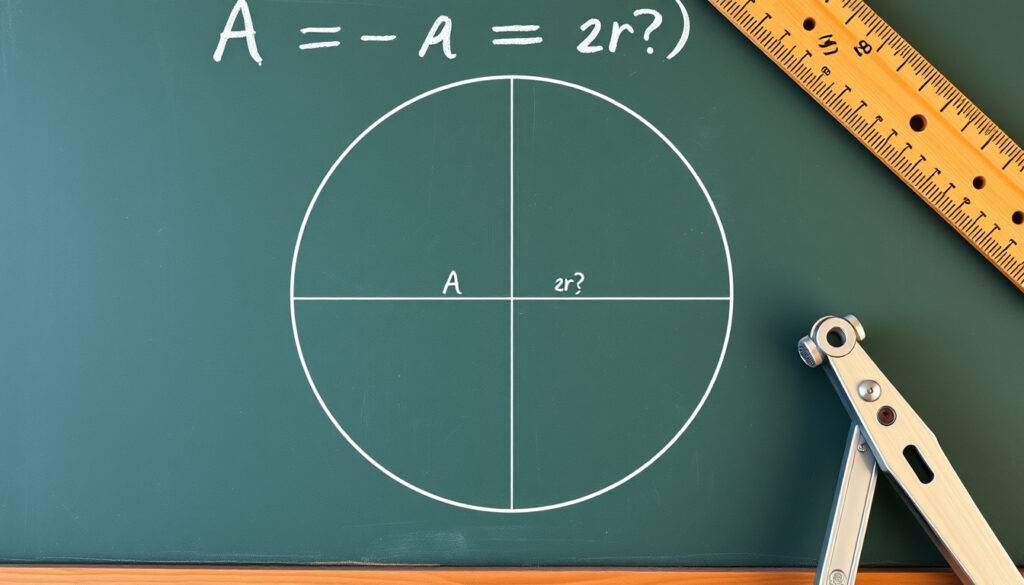
The core formula for the area of a circle is A = πr², where r is the radius and π (pi) is roughly 3.14159. This relationship applies to every perfect circle in Euclidean geometry, and it appears in contexts ranging from baking to aerospace engineering. As Albert.io (educational publisher) explains, the radius is simply the distance from the center of the circle to any point on its edge.
Using radius
- Square the radius (multiply it by itself).
- Multiply that result by π.
The implication: if you know the radius, the calculation is a clean two-step process with no intermediate conversions. Even beginners can follow this sequence without confusion.
Using diameter
- Divide the diameter by 2 to get the radius.
- Apply A = πr².
The trade-off: the diameter method adds one extra step, but it’s the only option when you don’t have the radius directly. Tutors.com (tutoring resource) emphasizes that students often skip dividing the diameter first — a common error that produces a result four times too large.
Using circumference
- Square the circumference.
- Divide by 4π.
The catch: this approach works but is less intuitive. You’re essentially solving for the radius through the circumference formula (C = 2πr), then plugging back into the area formula. For real-world problems where you only have a tape measure, it’s a valuable fallback.
A pizza maker measuring circumference with a string can still compute the surface area — and that means knowing exactly how much cheese to buy per pie.
The implication: the formula adapts to whatever measurement you have, making it versatile for real-world use.
How to work out the area from the diameter?
A frequent confusion: the area formula uses radius, but many real-world measurements (a pipe opening, a tabletop, a manhole cover) give you the diameter. The fix is mechanical but critical.
Divide diameter by 2 to get radius
The diameter of any circle passes through the center and touches two opposite points on the edge. Albert.io (educational publisher) states: the diameter is twice the radius. So the first step is always d ÷ 2 = r.
Square the radius
Once the radius is known, square it (r × r). This converts a linear measurement into a square measurement — essential because area is fundamentally two-dimensional.
Multiply by π
Finally, multiply the squared radius by π. Using 3.14 as an approximation yields a result accurate enough for most practical work, including construction and household projects. BYJU’S (educational platform) offers the equivalent formula A = πd²/4, which combines all three steps into one expression.
The catch: skipping the division step is the most common error, so double-check your radius before squaring.
How to calculate area?
Let the formula guide the process — step by step, with numbers you can follow.
Step-by-step calculation with radius
- Identify the radius. (If given the diameter, divide by 2 first.)
- Square the radius: multiply it by itself.
- Multiply that result by π (use 3.14 or the π button on a calculator).
- Report the result in square units.
Three steps. No shortcuts. As Albert.io (educational publisher) puts it, the beginner-friendly method is straightforward: find the radius, substitute it into A = πr², square, multiply.
Example calculations
A video lesson from Math with Mr. J (educational channel) works through a circle with radius 3 inches. Squaring 3 gives 9, multiplying by π (3.14) gives 28.26, and rounding to two decimal places yields 28.27 square inches. Another example: radius 5. Square 5 to get 25, multiply by 3.14 to get 78.50, or use the π button to reach 78.54. The difference? π’s extra digits.
For those who enjoy working with formulas in different contexts, you might also find this 1/2 Cup of Butter in Grams: Exact Conversion & Measurement Guide useful for similar step-by-step calculations.
Using 3.14 produces answers about 0.13% below the true value for most circles — negligible for homework but noticeable for precision engineering.
The pattern: more digits of π give more precision, but for everyday use, 3.14 suffices.
What are the two formulas for a circle?
Circles have two fundamental formulas — and confusing them is the most common mistake in school geometry.
Area formula
A = πr². This measures the surface enclosed by the circle. The result is always in square units: square inches, square meters, square feet. Tutors.com (tutoring resource) notes that the area of a circle is measured exclusively in square units.
Circumference formula
C = 2πr (or πd). This measures the distance around the circle — the perimeter, in non-geometric terms. The result is a linear measurement (feet, meters, inches), not square units.
The pattern: one formula gives you the inside, the other gives you the edge. They share the same π-and-radius structure, which is why students slip and use the wrong one. Albert.io (educational publisher) explains that circumference = 2πr while area = πr² — the squared radius is the visual tell.
The implication: always check the exponent to avoid the most common circle mistake.
Is 3.14 never ending?
Short answer: yes. That simple fact is why pi appears in geometry classrooms as an approximation — and why calculators have a dedicated π button.
What is π?
Pi (π) is the ratio of a circle’s circumference to its diameter. For any circle, that ratio is constant. Tutors.com (tutoring resource) states that π is the same constant ratio in every circle — and gives 3.14159265 as a decimal slice.
Why π is irrational
No matter how many decimal places you write, you will never reach the end. π is irrational, which means it cannot be expressed as a simple fraction of two integers. It is also non-terminating and non-repeating — the decimal digits go on forever without forming a repeating pattern.
“π is irrational, non-terminating, and non-repeating.”
— Tutors.com (tutoring resource)
Using approximations
- 3.14 — standard for most school math and everyday calculations.
- 22/7 — a fraction approximation, useful when calculators aren’t available.
- The π button on a calculator — gives 9-12 digits of precision.
The catch: the “exact” value of π is an infinite decimal that cannot be fully written. Every practical calculation is technically an approximation — but for nearly every real-world use case, the difference is irrelevant. Your pizza slices will be exactly the right size regardless.
We cannot write π down completely, yet we must use it to calculate areas. The workaround: approximations that are accurate enough for the task at hand — 3.14 for homework, more digits for satellites.
The upshot: approximations are practical and sufficient for nearly every use.
Learning from history: Archimedes and the circle
Around 250 BCE, a Greek mathematician named Archimedes took on the problem of the circle. He inscribed polygons inside circles and circumscribed polygons around them, tightening the bounds until he narrowed π to between 3.1408 and 3.1429. Albert.io (educational publisher) cites this as the first rigorous calculation of π. The principle Archimedes used — approximating a curved shape with straight-edged polygons — remains the conceptual foundation for how modern calculus proves that area = πr².
“The area of a circle is equal to that of a right-angled triangle whose legs equal the radius and the circumference.”
— Archimedes (c. 250 BCE), as transmitted through Albert.io (educational publisher)
Editor’s note: This paraphrase of Archimedes’ geometric insight captures his method — relating a circle’s area to a triangle with base equal to circumference and height equal to radius — which leads algebraically to πr².
For students struggling with the formula today, a Mathematics Online video (educational channel) makes the same connection visually: the video relates a circle to a rectangle and concludes that base times height becomes πr × r = πr². It’s Archimedes’ logic, updated for YouTube.
The formula A = πr² is over 2,200 years old. Its durability isn’t magical — it’s the result of a tight mathematical proof that holds for every circle, whether you’re drawing it on paper or calculating a planetary orbit.
For the student or DIYer, the implication is clear: the formula you use today is the same formula Archimedes derived using only polygons and logic. No special equipment required.
Frequently asked questions
What is the area of a circle with radius 10?
A = π × 10² = π × 100 ≈ 314.159 square units. If you use 3.14 for π, the result is 314 square units.
How do I remember the area formula for a circle?
Think of it as “pi are squared” — a silly phrase that sticks because it sounds like “pie are squared.” The actual formula is π × r × r.
Why is the area of a circle πr²?
The formula comes from slicing a circle into many thin wedges and rearranging them into a shape close to a rectangle. The rectangle’s height equals the radius, and its width equals π × r (half the circumference). Height × width = πr².
Can I use 3.14 for π in calculations?
Yes — for most schoolwork and everyday measurements, 3.14 gives results accurate to within about 0.05%. For engineering or scientific work, use the π button on a calculator for more digits.
What is the difference between area and circumference?
Area measures the space inside the circle (square units). Circumference measures the distance around the circle (linear units). Area uses πr²; circumference uses 2πr.
How to find the area if I only know the circumference?
Square the circumference, then divide by 4π. The formula is A = C²/(4π). For example, if C = 31.416, then A = (31.416²)/(4 × 3.1416) ≈ 78.54 square units.
What units are used for area of a circle?
Area is always expressed in square units — square meters (m²), square feet (ft²), square inches (in²), and so on. The unit matches whatever unit the radius (or diameter) is measured in. For more on measurement conversions, see our How Much Protein Do I Need – Calculator Charts and Guide.
For the reader who wants to practice, the simplest path is to grab a circle object (a plate, a clock face, a cup), measure its diameter, divide by 2, and run through A = πr². That direct experience — measuring and calculating — is what turns a formula on a page into a skill you own.
For students preparing for tests or homework, the choice is clear: master the radius method first, then add the diameter and circumference variants. For anyone using area calculations in real life — ordering materials, sizing projects, estimating paint coverage — keep a calculator with a π button handy. Students and DIYers can rely on this timeless formula for any calculation.
More related posts
 Color Laser Printer Scanner Buying Guide: Pros, Cons & Costs
 NZ News Today 2025 Breaking News: Latest Headlines & Updates
 S&P 500 Compare: Performance vs Alternatives
 Cheapest Unlimited Broadband NZ 2026: Plans Under $70
 Apartments For Rent Auckland – Prices, Top Suburbs and Tips
 Bledisloe Cup Kick Off Time 2026: All Blacks vs Wallabies
 Disney Cruise Auckland 2025: Schedule, Prices & Tickets
 James Nelson-Joyce: Bio, Net Worth, Relationships & More