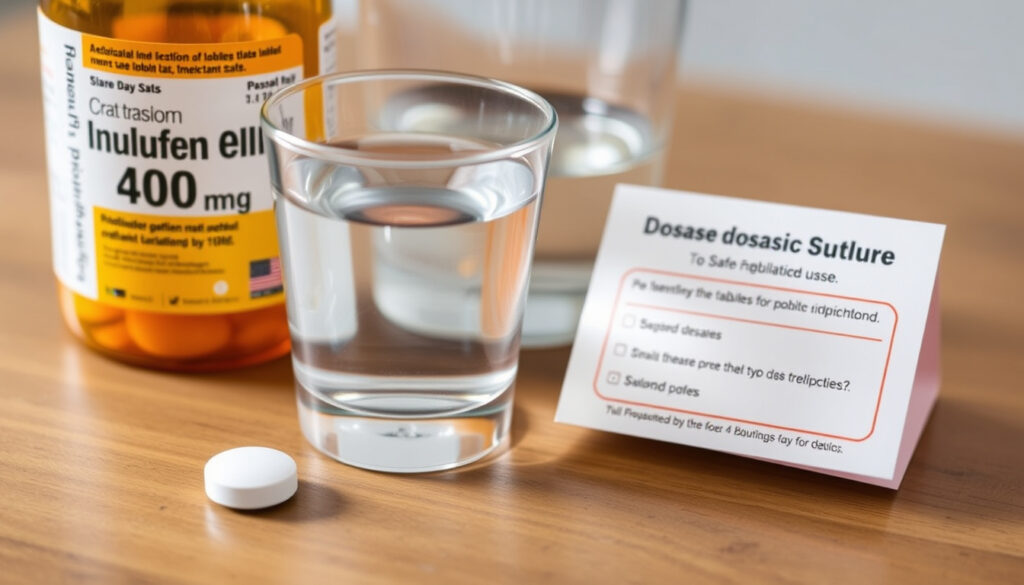
Ibuprofen 400mg Dosage for Adults: Safe Use Guidelines
Anyone who has stared at a pharmacy shelf in real pain knows the question: is one 400 mg tablet enough, or should I take two? Official drug information allows adults to take 400 mg every 4 to 6 hours as needed for pain (MedlinePlus (NIH drug guide)), with a prescription-label ceiling of 3200 mg per day (DailyMed (FDA label)). The gap between what the label allows and what adults should actually do with a 400 mg tablet is the whole story here.
Standard adult dose: 400 mg every 4 to 6 hours as needed · Maximum daily dose: 3200 mg (12 tablets of 400 mg) · Common uses: Pain, fever, inflammation · Onset of action: 30–60 minutes · Official source: DailyMed (NIH), FDA labeling
Quick snapshot
- Adults can take 400 mg every 4 to 6 hours as needed for pain (MedlinePlus (NIH drug guide)).
- For mild to moderate pain, 400 mg is the standard prescription unit, repeatable around the clock (Drugs.com (professional monograph)).
- The reviewed labeling does not define an optimal long-term schedule for chronic pain.
- No formal 400 mg dose adjustment is specified for adults with mild kidney impairment.
- Dose timing: one 400 mg tablet every 4 to 6 hours as needed (MedlinePlus (NIH drug guide)).
- UK product information caps a single adult dose at 800 mg (electronic Medicines Compendium (UK SmPC)).
- Follow the specific product leaflet: in the UK, 400 mg tablets cap the day at 1200 mg (electronic Medicines Compendium (UK patient leaflet)).
- If pain outlasts the acute window, the next stop is a clinician — not a self-selected higher dose. (electronic Medicines Compendium (UK patient leaflet))
The snapshot in one line: 400 mg is the right unit, 3200 mg is the wrong goal, and the official sources agree more than they disagree.
Key facts at a glance
Eight figures, one pattern: the US label sets a generous ceiling, while every guidance layer pulls adults back toward smaller, shorter, and more supervised use.
| Parameter | Value |
|---|---|
| Standard adult dose | 400 mg every 4–6 hours as needed |
| Maximum daily dose (US prescription label) | 3200 mg |
| Maximum single dose | 800 mg per dose |
| Arthritis dosing (adults) | 1200–3200 mg/day in 3–4 divided doses (Mayo Clinic (drug reference)) |
| UK maximum daily dose | 1200 mg |
| Common brand names | Advil, Motrin IB |
| Drug class | NSAID |
| Half-life | About 2 hours |
The pattern: the “maximum” rows are the ones most adults quote, and the “lowest effective dose” rows are the ones most adults skip — the table works best when read bottom-up.
What is the latest verified information about ibuprofen 400mg dosage for adults?
Three questions shape most adult decisions with a 400 mg tablet: how often, how much in a day, and how long. The answers come straight from the approved labeling — with one surprise for people who assume more is more.
FDA-Approved Dosing Regimen
- Prescription ibuprofen labeling for adults allows 400 mg every 4 to 6 hours as needed for mild to moderate pain (Drugs.com (professional monograph)).
- The same 4 to 6 hour rhythm repeats across independent US and UK drug information — the interval is the one number every source repeats.
The practical reading: 400 mg is a unit dose, not a plateau. The label’s four-hour minimum is a schedule, not a suggestion — stacking “one more” before the interval passes is the fastest way to turn a safe pill into an unsafe day.
Maximum Daily Limit and Duration
- The maximum total daily dose must not exceed 3200 mg — twelve 400 mg tablets if you are counting.
- The label instructs adults to use the lowest effective dose for the shortest duration, and controlled analgesic trials found doses above 400 mg no more effective than the 400 mg dose (DailyMed (FDA-approved label)).
- Higher totals — up to 3200 mg per day in three or four divided doses — belong to inflammatory conditions such as rheumatoid arthritis under a clinician’s care (Mayo Clinic (drug reference)).
The number to internalize: 3200 mg is a ceiling, not a target. Adults who treat it as “up to twelve tablets” will read the label wrong; adults who treat it as a fire alarm will read the label right.
Common Uses and Contraindications
Common uses: Pain, fever, inflammation · Drug class: NSAID · Standard form: 400 mg oral tablet
- The clear fit is acute pain — menstrual cramps, dental work, backaches, post-procedure flare-ups — where a single 400 mg tablet covers the gap until the body settles.
- US over-the-counter ibuprofen products carry a lower daily maximum than prescription-strength products, so “one OTC tablet” and “one prescription tablet” are not interchangeable math (Drugs.com (OTC drug reference)).
- The label’s standing instruction is to weigh potential benefits and risks before every course of use — the formal reminder that each dose has a price.
The label’s deeper message is almost philosophical: ibuprofen is dosed by the hour, not by the pain. When the effect fades after four to six hours, the instruction is to re-dose on schedule — not to escalate on impulse.
Two 400 mg tablets before the four-hour mark is already 800 mg in the system — and “as needed” does not reset the clock. The ceiling exists because the stomach and kidneys do not reset when the pain does.
The implication: the label already answers the “how much” question. One 400 mg tablet, on a timer, with a daily ceiling that exists to protect you from your worst pain day.
Which official sources confirm key claims about ibuprofen 400mg dosage for adults?
Four institutions carry the evidence on ibuprofen 400 mg for adults. Knowing which one owns which claim turns dosing advice from folklore into facts.
DailyMed (NIH) Labeling
- DailyMed, run by the US National Library of Medicine, hosts the FDA-approved prescribing information for ibuprofen tablets. It is the primary source for the 400 mg every 4 to 6 hours instruction and the 3200 mg daily ceiling (DailyMed (FDA-approved labeling)).
- Two details on that label matter most: the “lowest effective dose for the shortest duration” instruction, and the warning that doses above 400 mg were no more effective in controlled analgesic trials. Both come from the same FDA-approved document.
FDA Prescribing Information
- The label defines who may take 400 mg, at what interval, and for how long. It is the legal backbone of the drug — and the reason the word “maximum” always comes with “should not exceed.”
- It also frames every dose as a negotiated risk: potential benefits versus potential stomach and kidney effects.
Reading the FDA label directly is the single most reliable move anyone can make — it is the difference between knowing the dose and knowing why the dose exists.
Evidence from Controlled Clinical Trials
- The FDA labeling discloses what the marketing rarely does: doses greater than 400 mg did not outperform the 400 mg dose in controlled analgesic trials.
- That single finding is why clinicians start adults at 400 mg rather than aiming for the ceiling.
The pattern here: the official sources agree with unusual unanimity. Where they disagree — the UK’s 1200 mg cap versus the US 3200 mg cap — is regulatory conservatism, not conflicting science.
What are the most common user questions on ibuprofen 400mg dosage for adults?
Most adults don’t read the label until after the pain arrives. These are the questions that follow.
How often can I take 400 mg?
- Every 4 to 6 hours as needed — the interval appears consistently in the FDA-approved labeling, MedlinePlus, and the NHS product guidance.
- The packet is the final authority: the NHS tells adults to check the leaflet and follow the directions for the specific product.
- Setting a timer is the practical trick: if the alarm rings before four hours have passed, the answer is not a second tablet.
The mistake people make is treating “as needed” as “whenever I want.” The interval is the safety mechanism; skipping it converts a manageable drug into a stomach irritant and a kidney risk.
Can I take it with food?
- Yes — and the label’s workaround for gastrointestinal complaints is to take ibuprofen with meals or milk.
- A small meal protects the stomach without turning the dose into a guessing game.
The mini-rule: if your stomach knows you took the pill, the next dose goes with food.
What if I miss a dose?
- Ibuprofen is taken as needed, so “missed dose” works differently than with antibiotics — but the discipline is the same: resume the normal schedule and do not double up.
- With a 1200 mg daily cap in the UK and a 3200 mg cap in the US, catch-up dosing is reckless math. The ceiling is fixed; pain is not an exception clause.
The takeaway: dose by the clock, not by the pain.
The pattern: every common question resolves to one discipline — dose by the clock, not by the pain. That one habit prevents more ibuprofen problems than any warning label could.
The dose that controlled trials call “enough” is 400 mg — doses above it added no extra relief. Reaching for a second tablet before the interval passes trades a higher risk profile for zero additional efficacy.
Ibuprofen 400 mg: specifications
Nine specifications, one pattern: the 400 mg tablet is standard across markets, but the daily cap is where national labels disagree.
| Specification | Value |
|---|---|
| Standard adult dose | 400 mg every 4–6 hours as needed |
| Maximum single dose | 800 mg per dose |
| Maximum daily dose (US prescription label) | 3200 mg |
| UK maximum daily dose | 1200 mg (electronic Medicines Compendium (UK patient leaflet)) |
| Arthritis dosing | 1200–3200 mg/day in 3–4 divided doses |
| Onset of action | 30–60 minutes |
| Half-life | About 2 hours |
| Drug class | NSAID |
| Common brand names | Advil, Motrin IB |
The trade-off: the US label tolerates more, the UK label tolerates less, and neither is a license to ignore your stomach, your kidneys, or the other bottles in your cabinet.
The upsides and downsides of ibuprofen 400 mg
No drug gets a free pass. Here is the honest balance sheet for a 400 mg tablet.
Upsides
- 400 mg is the evidence-supported dose: controlled trials found no extra benefit at higher amounts.
- Flexible repeat interval: every 4 to 6 hours, as the pain demands, without a prescription in many markets.
- Well-documented across independent sources: NIH, NHS, and FDA-approved labeling all describe the same adult starting point.
Downsides
- The 3200 mg ceiling is easier to exceed than people think — twelve 400 mg tablets a day is the absolute limit, and counting goes sideways once you mix brands.
- GI irritation is the label’s central caution; food or milk is the workaround, and alcohol makes the trade-off worse.
- Daily high-dose use for inflammatory conditions belongs in a physician’s regimen, not a self-treatment plan.
The trade-off: 400 mg buys a lot of relief for a small price, and the price is paid by the stomach and kidneys when the daily total creeps upward.
How to take ibuprofen 400 mg safely: a step-by-step guide
Six steps between you and a complication-free dose.
- Confirm the strength. 400 mg tablets exist in both prescription and OTC forms depending on your market; read the front of the pack and the active-ingredient box.
- Start with one tablet. 400 mg is the standard adult unit for mild to moderate pain — the dose the trials found to be the effective plateau.
- Wait at least four hours. The label’s interval is 4–6 hours; the clock starts when the tablet enters your mouth, not when you feel better.
- Count the whole day. Total daily intake must not exceed twelve 400 mg tablets — and every brand, generic, and combined cold pill counts toward the same ceiling.
- Take with food or milk if your stomach complains. That is the label’s own workaround for GI upset.
- Reassess by day three. If pain keeps returning, the “shortest duration” instruction in the label means what it says: the next step is a clinician, not a larger dose.
The catch: step six is the one most adults skip — and skipping it is how occasional use becomes chronic use without anyone ever deciding to.
US prescribing allows up to 3200 mg per day; UK 400 mg tablets stop at 1200 mg. Same drug, same tablet, different ceilings — the product in your hand decides which rule you live under.
Confirmed facts vs. what remains unclear
What official sources agree on is easy to state — but the gaps are where adults get hurt.
Confirmed facts
- The FDA-approved adult regimen for mild to moderate pain is 400 mg every 4 to 6 hours as needed — DailyMed’s label states this directly.
- The maximum total daily dose is 3200 mg, and the label requires the lowest effective dose for the shortest duration.
- Controlled clinical trials in the FDA labeling found no added pain relief from doses above 400 mg.
What’s still unclear
- Optimal long-term dosing for chronic pain is not defined by current labeling, which assumes a short course.
- The exact risk profile for adults with mild kidney impairment is not specified in the reviewed sources.
- US OTC labels set a lower daily maximum than prescription-strength products, so switching bottles mid-day can silently change your ceiling.
- “One more tablet won’t matter” is the most dangerous arithmetic in OTC pain relief — the ceiling is a hard stop, not a guideline.
Why this matters: the label’s silence on long-term use is the loudest part of the document. A 400 mg dose was studied as an acute tool; every extra day of self-dosing walks further past the evidence.
Official guidance, in their own words
“Adults taking 400 mg ibuprofen tablets or capsules should check the packet or leaflet and follow the directions provided for that specific product.”
“The maximum daily dose for adults should not exceed 1200 mg for ibuprofen 400 mg film-coated tablets.”
— electronic Medicines Compendium (UK SmPC)
The pattern: each institution states a different slice of the same truth — the smallest dose that works is the right dose, and the daily cap is a backstop, not a benchmark.
Here is where the label and the habit separate. A 400 mg tablet is a tool, not a treat: the adults who get the most from it use the lowest effective dose, respect the four-hour interval, and treat 3200 mg as a ceiling rather than a target. For anyone reaching for ibuprofen more than a few times a month, the decision is clear: let a clinician own the long-term plan, or accept the stomach and kidney trade-offs that come with self-directed NSAID use.
dailymed.nlm.nih.gov, dailymed.nlm.nih.gov, dailymed.nlm.nih.gov, dailymed.nlm.nih.gov
Frequently asked questions
Can I take ibuprofen 400mg with acetaminophen?
Ask a pharmacist before combining. The reviewed labeling does not establish acetaminophen as a routine ibuprofen interaction, and that is exactly why a pharmacist should confirm — many combination cold products already contain acetaminophen, and overlapping doses are the real risk.
How long does it take for ibuprofen 400mg to work?
Expect meaningful relief within 30 to 60 minutes. That onset is why the label’s repeat interval is 4 to 6 hours — the drug is designed to be re-dosed, not front-loaded.
What should I do if I take too much ibuprofen?
Call a poison control center or seek emergency care immediately. The 3200 mg daily ceiling is a hard limit, and exceeding it usually happens by combining bottles — prescription 400 mg tablets one day, OTC tablets the next. Count every tablet from every source.
Can I take ibuprofen 400mg every day for arthritis?
For inflammatory arthritis, the approved adult range is 1200 to 3200 mg per day divided into three or four equal doses (Mayo Clinic (drug reference)) — but that is a physician-managed regimen. Self-selecting 400 mg three times a day without supervision is not the same as an arthritis treatment plan.
Is ibuprofen 400mg safe for elderly adults?
The reviewed sources do not establish a separate 400 mg dose for older adults, and that silence is itself a caution. Because kidney function often declines with age, the label’s “weigh benefits and risks” instruction becomes more urgent — a prescriber should confirm the dose.
Does ibuprofen 400mg raise blood pressure?
The sources reviewed here do not give a specific blood-pressure figure for a 400 mg dose. What the label does say is that benefit and risk must be weighed per patient — and for adults managing hypertension, that weighing belongs in a clinician’s office, not a pharmacy aisle.
Can I drink alcohol while taking ibuprofen 400mg?
The label’s caution is about your stomach: ibuprofen should be taken with meals or milk when GI complaints occur, and alcohol increases the risk of GI bleeding. On days you take 400 mg, the straightforward move is to skip the alcohol entirely.
What is the difference between ibuprofen and naproxen for pain?
Ibuprofen 400 mg acts quickly and can be repeated every 4 to 6 hours, up to 3200 mg per day. Naproxen’s longer half-life supports a different schedule, but that comparison requires a pharmacist’s or clinician’s input — the right choice depends on the condition, not the bottle size.
The pattern across all eight: the 400 mg tablet is a safe tool when the total day is controlled — and every other question is a variation on that single discipline.
More related posts
 NZ News Latest Today: Top Stories, Protests & Life in NZ
 Pacific Edge Share Price: Is PEB a Good Investment?
 Otago Anniversary Day 2025 – Date, History & Holiday Guide
 Current Flu in NZ 2025: Symptoms, Strains, and Severity
 Cast of Sex Education: Full List & Season 4 Newcomers
 Pizza Hut Near Me: Ireland Locations, Delivery & Deals
 One Battle After Another NZ: Where to Watch, Release Date & Flop Rumors
 What Is a Charter School in NZ? Kura Hourua Guide